For parents and educators, the promise of artificial intelligence in education is both exciting and daunting. We’re told that AI can tailor reading programmes, identify strengths and weaknesses, and recommend bespoke pathways faster than ever before. But as personalised learning technologies become more sophisticated, an essential question arises: How do we ensure personalisation doesn’t come at the expense of the human connection fundamental to learning?
Understanding Personalisation: The New Edge in EdTech Personalisation means more than auto-generated reading lists or smart assessments. In today’s EdTech landscape, AI is helping children learn at their own pace, spotlighting those who need extra support and celebrating unique learning journeys. Tools powered by machine learning, like the technology underpinning Fonetti’s Read Aloud Challenge, adapt to each child’s progress offering encouragement when needed and new challenges when ready.
While algorithms can identify patterns far more quickly than humans, they lack the empathy and intuition that only caring adults can provide. Without this human element, there is a real risk that education becomes a transactional process, reducing students to mere data points instead of nurturing them as individuals.
The Irreplaceable Role of Human Connection Research continually shows the value of teachers and parents who listen, understand, and advocate. When a child struggles with reading, it goes beyond correcting mistakes; The actual goal is to build confidence, resilience, and joy. AI can highlight which words are stumbling blocks, but it’s the adult’s patience and praise that make the breakthrough moments truly memorable.
In fact, many literacy experts believe the best results come from “AI-plus-human” partnerships. AI can suggest new books, flag disengagement, and recommend intervention, but only people can read the room, pick up on subtle emotional cues, and nurture lifelong curiosity.
Designing for Both: Lessons from EdTech Innovation Personalisation must always serve a human-centric learning experience. When developing speech recognition technology for reading aloud, the Fonetti team prioritises transparency and trust, where parents can track progress, and children always see their achievements celebrated by real people. Our technology never replaces the adult or teacher, but enhances and augments their feedback.
Thoughtful design ensures that every child’s reading journey feels personal, not impersonal. That means AI recommendations support, rather than dictate, choices, and young learners feel seen, heard, and understood.
Questions for the Future: Where Do We Draw the Line? As AI continues to evolve, the education community faces big questions. How far should automation go before it risks alienating the very learners it aims to help? What checks and balances ensure that EdTech remains accountable and inclusive? Further how do we support parents and teachers to harness AI’s power without sacrificing the warmth and wisdom that only humans bring?
At every step, the principle remains clear: personalisation must lead to connection, not isolation.
Conclusion: Empowered Learners, Human Teachers EdTech is reshaping classrooms and living rooms across the country. The challenge isn’t whether to use AI, but how to use it wisely. By keeping human connection at the heart of personalisation, we can help every learner reach their potential and ensure that technology supports, but never replaces, the magic of learning together.
When we think of reading aloud, we often see it as a stepping stone to helping children with vocabulary, fluency, and comprehension. Increasingly, research shows that its impact reaches much further. Reading aloud not only builds readers, it also promotes brain development. From memory to social understanding, and from confidence to connection, this simple habit brings lifelong benefits.
How Reading Aloud Shapes the Brain
Boosts Memory – Speaking words out loud improves recall, a phenomenon known as the production effect. By seeing, saying, and hearing words, children create stronger memory traces than through silent reading alone.
Strengthens Neural Connections – Reading aloud engages multiple systems at once: vision, speech, hearing, and language comprehension. This multi sensory workout reinforces the links between brain regions, building foundations for focus, problem-solving, and flexible thinking.
Supports Comprehension for Struggling Readers – For children who find decoding difficult, hearing text read aloud provides a framework for understanding. Assistive technologies, now used in many UK classrooms, show that combining audio with visual text can raise comprehension and confidence.
Benefits Beyond Literacy Reading aloud helps children develop skills that extend well beyond the classroom:
Attention and focus: Following along encourages concentration.
Imagination: Stories stimulate mental imagery and creative thinking.
Empathy and perspective: Hearing stories deepens emotional understanding.
Confidence and independence: Shared reading empowers children to engage with texts they might find challenging alone.
Stronger relationships: Reading together nurtures bonds between children, parents, and teachers.
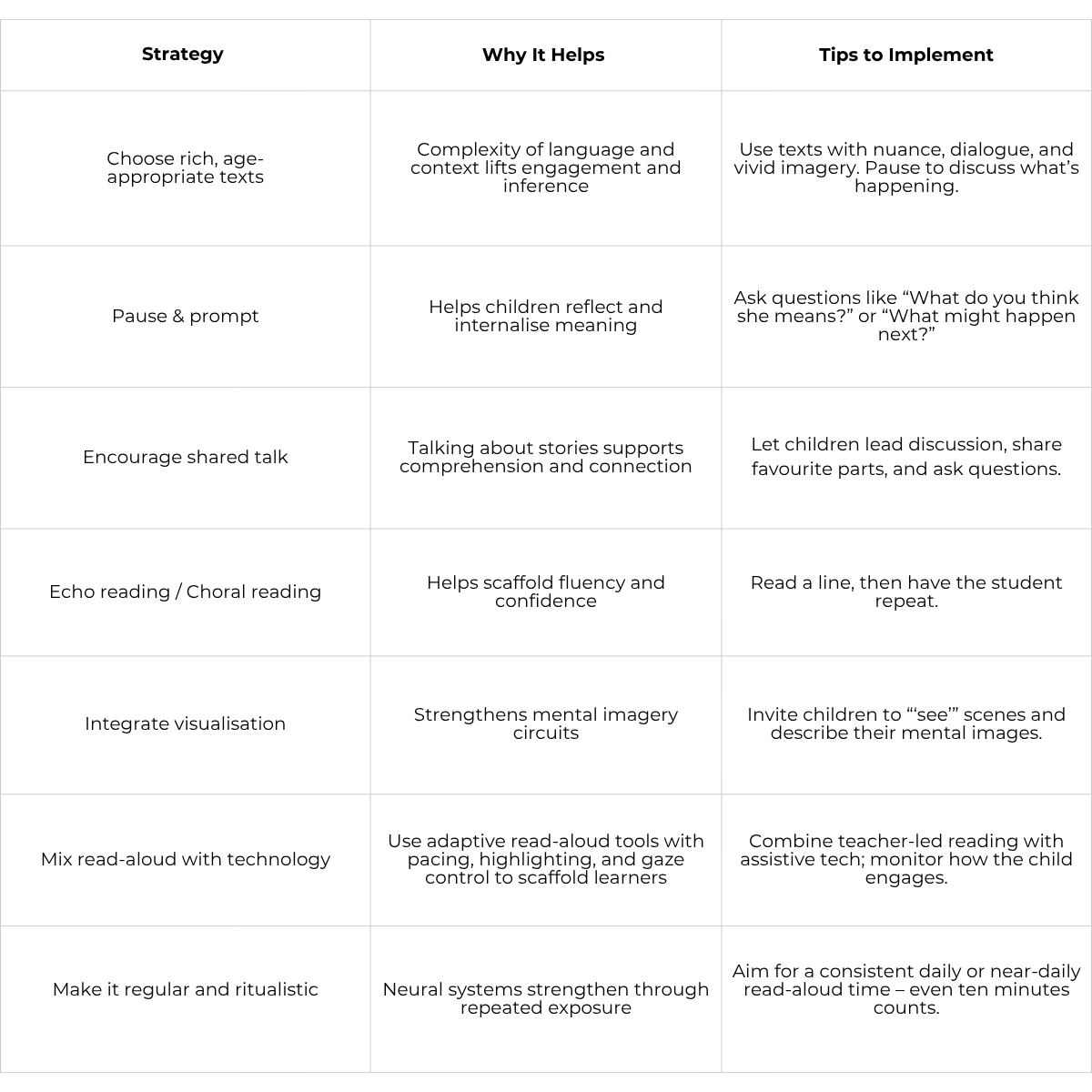
Practical Strategies for Parents and Teachers To maximise the brain-building benefits of reading aloud, here are strategies you can adopt:
The Role of Technology, and the Rise of ASR As educational practice evolves, digital tools now play a significant part in making read-aloud more accessible and engaging. A key advancement is Automatic Speech Recognition (“ASR”) technology. ASR offers direct, real-time feedback as children read aloud, helping them refine fluency and accuracy independently. This proves invaluable for those children who may not have adult support at home, allowing them to build confidence through solo practice.
For teachers, ASR applications provide data and analysis regarding each child’s reading performance, helping guide in-class learning and allowing for targeted intervention. Many solutions also incorporate gamification badges, progress scores, and reading challenges – which serve to increase engagement and motivation in young readers.
Looking Ahead: Read-Aloud in a Changing World For parents, reading aloud is a daily ritual that goes beyond story time. Only ten minutes of shared reading can boost a child’s confidence, imagination, and sense of connection. For teachers, it is a proven strategy to support comprehension, especially when layered with evidence-based practices and adaptive technologies now widely available in UK classrooms.
Digital platforms utilising ASR, now put these scientific principles into practice. Fonetti, for example, uses ASR to provide children with instant feedback on their reading, while engaging them through gamified rewards and progress tracking. This fusion of science and technology helps struggling readers build independence, without diminishing the human connection found in shared reading experiences.
The opportunity for both parents and educators lies in treating reading aloud not as an optional extra, but as a cornerstone of development. It is a practice that supports brain growth, literacy, and, ultimately, the life skills young people need to thrive in the ever-changing future.
Once upon a time, in a small mining village in South Yorkshire, there was a boy who hated reading. For young David Lawrence Jones, stories felt like chores, words like barriers. He was certain he’d never be a reader.
And yet, everything changed in the most unexpected way.
That boy who once dreaded opening a book grew up to become one of the UK’s most beloved children’s authors, a tireless champion of literacy, and the creative mind behind bestselling adventures and even a hit animated educational series. Today, David Lawrence Jones inspires thousands of children every year – proving that sometimes, all it takes is a single spark to set a lifelong love of reading ablaze.
But how did a reluctant reader become the author who now dedicates his life to helping children discover the magic of books? The story begins with one simple gift from his teacher – a gift that would change his life forever…
David Lawrence Jones’ Early Reading Journey
How a Teacher’s Gift Turned David into a Reader David was born in 1964 in the mining village of Ravenfield, near Rotherham in South Yorkshire. Like many children, he was a reluctant reader – he simply didn’t want to pick up a book. No matter how hard his mother tried, nothing could spark his interest. Reading felt like a chore to be avoided at all costs. But everything changed in 1971, when David was just seven years old. It all began with a simple yet extraordinary idea from his school teacher – an idea that would transform David’s world. Instead of pushing him to read, the teacher decided to give him a present.
And children love presents. David was no exception.
One day, his mother arrived home with a carefully wrapped package bearing his name. Excitement bubbled inside him as he tried to guess what might be inside. A toy? A game? His imagination raced.
But when he tore off the paper, he found… a book.
Disappointment hit. A book? Really? The last thing David wanted was more reading. Yet there it was: a story from Enid Blyton’s Secret Seven series – seven child detectives with a keen eye for mystery and adventure. Ironically, it was David’s own curiosity – just like the Secret Seven’s – that began to stir. What was inside those pages? Could it really be that bad to read just a few?
He gave in. And from the moment he began following Peter, Janet, Pam, Barbara, Jack, Colin and George through their thrilling investigations, he was hooked. He didn’t just finish the book – he devoured it. That one gift had cracked the case: David was now a reader. From that moment on, his relationship with books was transformed forever.
From Bedtime Tales to Bestsellers Although it took time for David to fall in love with reading, his imagination had always been alive. Sharing a bedroom with his older brother, he would invent bedtime stories – not out of any grand plan, but simply to keep his brother quiet at night! Yet those whispered tales planted the seeds of something much bigger.
Years later, parenthood opened the door to an extraordinary twist of fate. In 2009, while browsing the shelves of his local Waterstones in Torquay with his young daughter, David stumbled across a Community Activity Scheme inviting local unpublished authors to submit their work. He seized the moment. Soon after, his first book – Bradley Baker and the Curse of Pathylon – was published. Readers were captivated by Bradley’s daring quest to save the king and break an ancient curse. The book didn’t just sell – it flew off the shelves. Within weeks, David had achieved the second-highest sales in his store’s location.
What began as a chance encounter quickly grew into a full-fledged career. David toured Waterstones stores, hosting lively “meet-the-author” events and securing further publishing deals. Since then, he has written four more books in the bestselling Bradley Baker Adventure series, cementing Bradley as a firm favourite among young readers.
But David didn’t stop there. His imagination created Jig and Saw – a tale of a brother and sister who discover a magical cupboard leading to a land of board games – and Devon Farm Adventures, a rhyming picture book series introducing children to the joys of countryside life. Both, now available on Fonetti, continue David’s mission to spark the same wonder that first lit up his imagination as a child.
David Lawrence Jones Inspiring Young Readers
A Mission to Inspire a Love of Reading: Interactive Showcase Presentations Since becoming a published author, David has dedicated his life not only to writing captivating stories but also to sharing the joy of reading with children across the UK. His high-energy school tours are legendary – packed with theatrical flair, colourful props (including his famous glowing bathtub!), and endless opportunities for children to join in the adventure.
In 2025, he returns to schools nationwide with renewed passion and a new two-day format: a whole-school showcase followed by a book signing where children can meet him, ask questions, and take home signed copies. Demand is higher than ever, with over a hundred schools booking him each year – most through glowing recommendations. As David often jokes, “How long will I keep presenting at schools?… Until I collapse in an exhausted heap – as long as my books continue to inspire children to read.”
Literacy Workshops Beyond the stage, David leads smaller, hands-on workshops where pupils create their own characters, storylines, and comic strips. They experience the full writing process – planning, drafting, editing, and proofreading – boosting their confidence as young authors. Many schools combine a showcase with a workshop, ensuring even the most reluctant readers leave inspired.
Super Geek Heroes & Super Geek Island Never one to stop at the page, David also created The Super Geek Heroes, a 3D animated series blending fun, adventure, and education for early years learners. The seven super-kids – Ant Active, Ronnie Rock, Millie Maths, Jake Jotter, Suzi Smiles, Peter Planet, and Vicky Voice – each represent a key Early Years Foundation Stage (EYFS) goal, turning learning into superhero missions. Building on this success, David co-founded Super Geek Island, an interactive online platform for EYFS learners to dive deeper into the world of learning.
Chancellor of the Devon & Cornwall Children’s University Since 2012, David has proudly served as Chancellor of the Devon & Cornwall Children’s University, helping give children aged 5 to 14 access to enriching learning opportunities outside school. To support the cause, he even wrote Cub’s Adventures, following the University’s mascot across the South West to a graduation ceremony at the University of Plymouth. Through this role, David champions social mobility, ensuring every child – whatever their background – has the chance to dream big.
From packed school halls to intimate workshops, from bestselling books to animated adventures, David’s mission has remained the same: helping children discover the joy of reading and the confidence to keep turning the page.
Celebrating Young Readers and Literacy Achievement
A Shared Mission – How David’s Passion for Literacy Resonates with Fonetti David’s journey – from reluctant reader to bestselling author – resonates deeply with Fonetti’s vision. Having once struggled himself, he understands the challenge of sparking a child’s interest in reading better than most. That early struggle makes his mission – and his success in helping others – all the more powerful.
At Fonetti, we share that mission: to ensure every child discovers the joy of reading. Like David, we believe it’s not just about stories, but about confidence, opportunity, and giving children the tools to succeed. Just as David uses creativity and fun to inspire young readers, Fonetti harnesses cutting-edge technology, using ASR and AI to provide real-time feedback that keeps children engaged and progressing.
It’s why we’re so proud to host David’s Jig and Saw and Devon Farm Adventures series on Fonetti, so even more children can enjoy them and discover the magic of reading for themselves. You can explore David’s books right now on Fonetti. For those who’d like to purchase his books directly or book David for an unforgettable school visit, we’ve included a link to his official website below, along with links to The Super Geek Heroes animation series and Super Geek Island learning platform.
David Lawrence Jones proves that no child is ever truly a reluctant reader – they just haven’t found the right story yet. At Fonetti, we’re proud to share his stories and continue his mission: ensuring every child has the chance to discover the magic of reading.
Imagine if, instead of just turning pages, a book could listen. What if it could gently prompt a child when they misread a word, cheer them on when they pronounce something correctly, and track their progress over time – all without needing an adult to hover nearby?
This is no longer the stuff of imagination. Thanks to Automatic Speech Recognition (ASR), books are beginning to talk back. And for young readers, that changes everything.
📖 The Traditional Reading Model – and Its Limits For generations, reading has been a largely one-way experience. A child sits with a book and decodes the words on the page. When possible, a parent, teacher or older sibling might listen, correct mispronunciations, and encourage fluency. But in busy homes and overstretched classrooms, this kind of attentive one-to-one support isn’t always available. That’s where children can fall behind – not for lack of will, but for lack of real-time, personalised feedback.
💡 Enter ASR: A Reading Revolution Automatic Speech Recognition bridges this gap. When embedded in EdTech tools like Fonetti, ASR listens as a child reads aloud, assessing accuracy and fluency in real time. If a child stumbles, skips a word, or mispronounces something, the technology gently flags it. If they improve, it celebrates them. This creates an interactive loop: the child reads, the technology listens and responds, and the child adjusts – learning as they go. It’s the kind of responsive support that builds not just literacy, but confidence.
🔄 Practice, Feedback, Progress The secret sauce in learning to read fluently is repetition with feedback. ASR tools encourage children to read aloud more often – something that traditional reading apps or eBooks rarely promote. And because the feedback is immediate, children begin to self-correct. They develop an ear for their own accuracy. Over time, this builds fluency, comprehension, and a deeper sense of achievement. It’s no longer about “getting through the page” – it’s about reading well, and knowing you’re reading well.
🧑🏫 Supporting Teachers with Actionable Insights One of the often-overlooked benefits of ASR technology is the visibility it provides to teachers. With platforms like Fonetti, teachers gain access to a dedicated portal that tracks each pupil’s reading activity – including accuracy, fluency, and consistency over time. This data helps teachers quickly identify which pupils are thriving and which ones may need targeted support – whether it’s help with decoding, pronunciation, or reading stamina. In short, ASR doesn’t just support the child – it supports the whole classroom ecosystem.
By freeing up time and providing clear insights, ASR allows teachers to do what they do best: personalise learning and support every child, no matter their starting point.
🌍 Accessible, Scalable, Empowering Perhaps one of the most powerful aspects of ASR is its scalability. Not every child has daily access to an adult who can sit and listen while they practise reading. ASR levels the playing field – bringing high-quality support into homes, classrooms, and communities where it might otherwise be lacking. It empowers teachers with data. It gives parents peace of mind. And most importantly, it gives children a sense of ownership over their reading journey.
🚀 The Future of Reading Is Interactive Reading doesn’t have to be passive. With the help of ASR, we’re moving toward a world where every child can hear how they’re doing, see their progress, and feel proud of how far they’ve come. At Fonetti, we believe books should be engaging, encouraging – and just a little bit magical. And when books talk back, that magic becomes real.
📢 Try It for Yourself: Join the National Read Aloud Challenge! If you’re curious about how ASR can support your child’s reading, there’s no better time to give it a go. The National Read Aloud Challenge is still open – and it’s the perfect opportunity for children to experience Fonetti’s interactive, voice-powered reading platform for themselves.
Whether your child is a confident reader or just starting out, the challenge is designed to encourage regular reading aloud and make it fun. With built-in feedback, progress tracking, and a growing library of engaging stories, Fonetti helps every child become a stronger, more fluent reader.
In a world increasingly shaped by information, communication, and digital access, the ability to read with confidence and understanding is more essential than ever. Yet, the latest findings from the OECD’s Survey of Adult Skills (PIAAC) suggest that literacy among working-age adults in England is not improving – in fact, it’s getting worse.
The PIAAC study assesses the literacy skills of adults aged 16 – 65 across OECD countries, rating their reading ability on a scale from 0 to 5. A score of Level 3 is seen as the minimum required to meet the demands of everyday life – things like understanding workplace emails, navigating healthcare information, and interpreting official forms. Scoring Level 1 or below is considered to reflect very poor literacy, severely limiting someone’s ability to participate in society and the workforce.
This blog will delve into the latest set of results and what the implications are for working-age people, employers and society as a whole. But if you’d like to read the results for yourself, you can access them here: Survey of Adult Skills 2023: national report for England – GOV.UK
A Stagnant – or Slipping – Picture at the Top In 2019, nearly half of working-age adults in England (49.47%) were assessed as being below Level 3. At the time, this raised alarm bells about how well the education system was preparing people for the demands of modern life.
Fast forward to the latest results in 2024, and the situation has not improved. In fact, the proportion has risen slightly to 50% – equivalent to an estimated 18.34 million adults lacking the literacy skills needed to confidently manage everyday tasks. This isn’t just a statistic. It’s a reflection of millions of people potentially struggling to:
Write clear emails or reports at work
Understand letters from their GP or local council
Help their children with homework
Access government services online
For businesses, it can mean decreased productivity, greater training needs, and communication barriers. For individuals, it can mean limited job opportunities, lower income, and reduced confidence.
A Worrying Rise in Very Poor Literacy Even more concerning is the rise in adults scoring Level 1 or below – those with very poor literacy skills. In 2019, this group made up 16.36% of adults in England. In 2024, that figure has risen to 18% – representing around 6.6 million people. This level of literacy can mean struggling to:
Understand written safety instructions
Read a timetable or menu
Fill in a simple form
Follow medicine dosage information
For these adults, the barriers to employment, health, and full social participation are profound. The risk of social exclusion, long-term unemployment, and poor mental health is significantly higher.
Why This Matters – And What Fonetti Is Doing About It These findings are more than a wake-up call – they are a clear indicator that literacy support must start early, and it must be sustained. At Fonetti, we believe that tackling the adult literacy crisis begins with how we teach children to read. Our platform uses Automatic Speech Recognition (ASR) technology to support children reading aloud – one of the most effective ways to build fluency, comprehension, and confidence. By offering real-time feedback and encouragement, Fonetti helps young readers develop strong literacy foundations before they fall behind. The OECD data makes one thing crystal clear: the cost of poor literacy is not just individual – it’s societal. But by investing in the right tools, delivered at the right time, we can change the trajectory for the next generation.
Let’s not wait for the next report to show us what we already know.
Let’s build a future where every child – and every adult – can read with confidence.
Last week, the Department for Education, in conjunction with the National Literacy Trust, announced that 2026 will be the National Year of Reading – and as a company that has spent a decade working to improve children’s reading, we couldn’t be more delighted.
In a speech made by Education Secretary Bridget Phillipson, the campaign pledged to shine a spotlight on reading, with a particular focus on reading for pleasure. The initiative aims to reignite children’s love of books, recognising that fostering enjoyment is one of the most effective ways to improve literacy levels – and transform lives.
The Reading for Pleasure Challenge The decision comes at a crucial time. Data from the National Literacy Trust shows a worrying decline in reading for pleasure among children and young people aged 8-18. In fact, their 2025 survey revealed that just 32.7% of children said they enjoyed reading in their free time – the lowest figure recorded since the Trust began collecting this data in 2005. This trend has been steadily worsening, and the consequences are significant.
Why Reading for Pleasure Matters Reading for pleasure isn’t just about fun – although fun is a crucial part of it. It’s about building confidence, curiosity, and fluency. Numerous studies have shown that children who enjoy reading are more likely to perform well across the curriculum, develop stronger vocabulary, and have better mental wellbeing. It’s one of the single biggest predictors of future academic success – even more so than a parent’s level of education or socio-economic background.
Why Fonetti Supports the National Year of Reading At Fonetti, we’ve long believed that every year should be the year of reading. But we wholeheartedly support the government’s renewed focus, especially its emphasis on reading for pleasure. We’ve always said that helping children love reading is the key to improving their reading skills – and we believe technology has a powerful role to play in making that happen. Fonetti was built on this belief. Our interactive, speech recognition-powered reading app helps children read aloud with confidence and independence, while making the experience engaging, gamified, and fun. As children grow up surrounded by screens, we believe in using that to our advantage. By bringing together the best of edtech and education, we can help turn screen time into story time – and stories into stepping stones for lifelong learning.
Our recent white paper, commissioned by Auris Tech, explores exactly this: how Automatic Speech Recognition (ASR) technology can support children’s reading development and promote reading for pleasure. The research makes clear that ASR offers a scalable, interactive and child-friendly solution to some of the biggest challenges in literacy education today. If you haven’t read our whitepaper yet it can be accessed here: Reading Aloud Using Automatic Speech Recognition (ASR) To Improve Children’s Reading — Auris Tech
Looking Ahead We’re proud to stand with the Department for Education, the National Literacy Trust and all the organisations rallying behind this campaign. The National Year of Reading 2026 is a welcome opportunity to refocus attention, energy and innovation on one of the most important issues of our time: ensuring every child has the tools, confidence, and love of reading they need to thrive.
National Literacy Trust data from early 2025 paints an alarming picture – how Fonetti is stepping in to help
The National Literacy Trust (NLT) has just released its latest figures on children’s and young people’s reading habits for the first half of 2025. Based on responses from over 114,000 pupils across 515 UK schools, the findings are nothing short of concerning.
This data snapshot, covering the first five months of the year, reveals a continued and dramatic decline in both readingenjoyment and daily reading frequency among children aged 5 to 18. In this blog, we’ll summarise the report’s most worrying findings – and explain how at Fonetti, we’re working to reverse this trend using cutting-edge technology that makes reading not just a habit, but a joy.
📚 1. Reading Enjoyment Continues to Fall Perhaps the most distressing figure from this year’s report:
“Just 1 in 3 (32.7%) children and young people say they enjoy reading.”
This is the lowest figure recorded in two decades, representing a 36% decline in reading enjoyment since 2005. Even more worrying is the steep drop in enjoyment among primary-aged children and boys aged 11 – 16; a group already at greater risk of falling behind in literacy. Reading for pleasure is strongly linked to academic success, emotional well being, and future life opportunities. When children stop enjoying books, we lose more than just reading time – we lose connection, curiosity, confidence, and a vital developmental tool.
📉 2. Reading Frequency is at an All-Time Low The number of children who read daily in their free time is also plummeting. In 2025, fewer than 1 in 5 (18.7%) 8- to 18-year-olds said they read something every day outside school – the lowest level ever recorded by the NLT.
Among 5- to 8-year-olds, daily reading fell to 44.5% – a decline of 3.4 percentage points just since 2024.
The daily reading gap between girls and boys has widened to 6.2 percentage points – the biggest since 2023.
Children receiving Free School Meals (FSMs) are reading less frequently than their peers: 15.8% vs. 19.4%.
These aren’t just numbers. They’re warning signs. Children who aren’t reading daily – especially those in underserved communities – are more likely to struggle with reading attainment later in life.
🔊 3. How Fonetti Is Helping to Turn the Page At Fonetti, we believe every child deserves the joy of reading – and the confidence that comes with it. We also know that traditional approaches aren’t working for every child. That’s why Fonetti harnesses Automatic Speech Recognition (ASR) to bring reading to life in a whole new way. With Fonetti, children read aloud to their device – and the app listens, understands, and encourages them in real time. This not only builds fluency and comprehension, but also restores the sense of pride and fun that should come with reading.
What makes our approach different?
Instant feedback – boosts confidence and motivates kids to keep going
Gamified experiences – make reading feel like play, not homework
Parental and teacher dashboards – track progress and celebrate milestones
We reach children who might not otherwise enjoy reading – from reluctant readers to those with learning differences
Our mission is to reignite reading enjoyment and improve literacy outcomes for every child, no matter their background or reading level.
🛑 It’s Time to Act The latest data is not just a wake-up call – it’s a call to arms. The UK is facing a literacy crisis, and it’s our responsibility as educators, parents, and tech innovators to respond with urgency and creativity. At Fonetti, we’re committed to using the power of voice, technology, and joyful design to help more children fall in love with reading again.
We invite you to be part of the solution.
📲 Learn more about Fonetti and how it supports children’s reading: www.fonetti.com
No discussion about EdTech would be complete without addressing the ever-present topic of screen time. In an age where children are spending more time than ever online, it’s understandable that many parents and educators feel cautious about actively encouraging further device use – even when it’s for educational purposes.
Concerns about excessive screen time are well-founded. Research links high screen usage to a range of risks: increased chances of obesity, disrupted sleep patterns, eye strain, and mental health challenges such as anxiety and depression. But here at Fonetti, we believe there’s an important nuance that often gets overlooked: not all screen time is created equal.
In fact, when designed with care and used in moderation, educational technology and AI tools can offer powerful opportunities for child development. It’s time we shift the conversation from how much screen time is too much, to what kind of screen time children are engaging in.
Active vs Passive Screen Time: Understanding the Difference The key distinction lies in how children interact with their screens. Passive screen time – such as binge-watching shows or endlessly scrolling through social media – can certainly be problematic, especially in large quantities. It tends to displace physical activity, interrupt sleep, and limit real-life social interaction.
But active screen time is a different story. Interactive technologies that encourage engagement, creativity, and problem-solving can be incredibly beneficial. Whether it’s reading aloud, solving puzzles, or exploring digital stories, these activities stimulate rather than stifle development.
At Fonetti, we build reading tools that actively involve children – inviting them to read aloud, receive instant feedback, and stay engaged in a constructive and purposeful way.
Meeting Children Where They Are Children are growing up in a digital-first world. For many, screens are not a novelty – they’re a normal part of everyday life. That’s why positioning reading as an activity that fits seamlessly into this digital routine makes so much sense. Rather than presenting reading as a chore or a task separate from “fun” activities like gaming or video watching, EdTech allows us to blur that boundary. Reading on-screen becomes something children choose, enjoy, and even look forward to.
This shift in perception could have a surprising benefit: it may reduce the amount of truly passive screen time children consume. In replacing endless video-watching with a reading app, children aren’t just learning – they’re avoiding exposure to potentially inappropriate content too. Unlike open web platforms, EdTech environments like Fonetti are carefully curated and age-appropriate by design.
Digital Reading as a Stepping Stone Ironically, using technology to encourage reading might actually reduce children’s dependency on screens over time. Here’s why: developing reading confidence early on opens the door to a whole world of non-digital pastimes.
Children who enjoy reading are more likely to pick up physical books, explore written materials, and feel empowered in their education. By gamifying and digitalising the reading journey, we lay the foundations for skills and habits that extend well beyond the screen.
Technology as a Social Connector Another overlooked advantage of EdTech is the social layer it can offer. Reading becomes something children can do with others – whether that’s tracking books with friends, sharing favourites, or even engaging in friendly reading challenges.
For parents and teachers, this technology opens up new avenues for involvement. Features like progress tracking and reading insights allow adults to follow a child’s journey closely and provide support where it’s needed most – without disrupting the child’s independence or flow.
How Fonetti Encourages Positive Screen Time At Fonetti, we’re proud to champion a vision of screen time that’s positive, purposeful, and productive. We know that improving children’s enjoyment, confidence, and frequency of reading is key to reversing the stagnation in literacy progress – and we believe technology can be part of the solution. Our app uses Automatic Speech Recognition (ASR) to transform reading into an engaging, interactive experience.
ASR enables children to read aloud independently while receiving real-time feedback, allowing them to build fluency and confidence on their own terms. At the same time, parents and educators can access insightful data on reading habits and progress – all within a safe, structured, and empowering environment.
In summary The screen time debate is complex, but it’s not black and white. When used thoughtfully, EdTech can be a force for good – helping children build crucial skills, stay engaged with reading, and ultimately thrive in a digital world.
Let’s move beyond fear and focus on the future: a future where screen time supports learning, connection, and growth.
Can Children Develop Their Reading Skills Better With Reading Aloud? When incorporating ASR (Automatic Speech Recognition) technology into children’s reading, reading aloud is the primary method used. This allows the technology to assess and track their reading development. While silent reading certainly has its place in a well-rounded reading strategy, there is a compelling case for giving reading aloud a more prominent role.
But how does reading aloud compare to the traditional method of silent reading when it comes to developing children’s reading skills?
What is Reading? To compare the benefits of reading aloud and reading silently, it’s essential to understand what reading involves. According to the national curriculum, the ‘Simple View of Reading’ model proposed by Philip Gough and William Tunmer (1986) breaks reading down into two main components:
Decoding (word reading) – the ability to recognise words, often by sounding them out and blending phonemes together.
Language comprehension – the ability to derive meaning from words, sentences, and context.
Both decoding and comprehension are necessary for becoming a proficient reader. Research shows that once children can decode accurately and quickly, putting in the ‘reading miles’ is key to further development.
How Reading Aloud Supports Decoding Skills
Phonics and Word Recognition Children learn to decode words through phonics instruction, typically in Key Stage 1. The introduction of phonics screening checks in 2012 has led to significant improvements in word recognition, with 89% of pupils meeting the expected standard by the end of KS1 in 2023.
While phonics instruction is crucial, reading aloud reinforces these skills by exposing children to phonemes in different contexts and improving recall. Producing sounds themselves – rather than simply imagining them through reading silently – enhances their ability to internalise letter-sound mappings. This is especially helpful for encountering unfamiliar words.
Fluency Development Fluency acts as a bridge between decoding and comprehension. A fluent reader reads accurately, at an appropriate speed, and with correct intonation (prosody). The Standards and Testing Agency (STA) suggests that reading at around 90 words per minute is a good fluency benchmark for KS1 pupils. Reading aloud helps children:
Adjust their reading speed to avoid stumbling.
Engage more with punctuation for natural-sounding speech.
Apply stress and intonation, making reading more engaging.
Greater fluency fosters enjoyment, encouraging children to read more often.
Oracy and Speaking Skills Reading aloud also strengthens oracy skills – the ability to express oneself clearly through spoken language. Surveys suggest pupils who would benefit most from more speaking activities include:
Pupils with English as an Additional Language (EAL) –- 73%
Disadvantaged pupils – 71%
Pupils with low attainment – 68%
Reading aloud provides a valuable opportunity to develop these skills, particularly for children from language-poor households with fewer conversational opportunities.
Building Confidence Confidence is a significant barrier to participation in reading and public speaking activities. Only 45% of children reported feeling confident in their reading in 2021, a drop of 8 percentage points from 2016. Reading aloud, especially in a private setting, allows children to build confidence independently before progressing to reading in front of peers.
How Reading Aloud Supports Language Comprehension
Closing the Vocabulary Gap Before children learn to read, they develop vocabulary through speaking and listening. However, children from language-poor households hear significantly fewer words than their peers. Studies estimate this ‘word gap’ can reach tens of millions of words by the time children start school. For example, children from literacy-rich households who are read to regularly will have heard 1,483,300 words by age five, compared to 63,750 words for those read to only a few times a week.
Reading aloud can bridge this gap by providing additional language exposure and reinforcing new vocabulary through speaking practice.
Improved Retention and Recall Reading comprehension depends on the ability to retain and recall information. Research consistently shows that children remember words and information better when they read aloud compared to reading silently. One study found that children recognised 87% of words read aloud compared to 70% of words read silently.
This is due to the ‘production effect’ – the combination of speaking words (motor activity) and hearing them spoken (auditory input), which strengthens memory retention.
The Education Endowment Foundation (EEF) recommends oral reading as a method for improving comprehension, and studies suggest oral language training leads to significant improvements in reading comprehension.
Key Takeaways: Reading Aloud vs. Silent Reading The reading framework states that reading volume – or “reading miles” – is critical to developing reading skills. While both reading aloud and silent reading contribute to this, reading aloud has distinct advantages:
Supports phonics progress – Reinforces phonics knowledge through active speech production.
Develops fluency – Helps children read more naturally with appropriate pacing, stress, and intonation.
Improves oracy skills – Enhances spoken language abilities, particularly for disadvantaged pupils.
Builds confidence – Reduces anxiety around public reading and speaking.
Enhances retention and recall – The ‘production effect’ leads to greater memory of words and information.
Given these benefits, reading aloud should play a greater role in national reading strategies. Increased emphasis on reading aloud in education frameworks and curricula could significantly enhance children’s reading proficiency, confidence, and overall language development.
The Current State of Children’s Reading in the UK The state of children’s reading in the UK is concerning. In the 2023/24 academic year, 26% of Year 6 pupils in England left primary school without meeting the expected standard in reading. This statistic has remained stagnant over time, highlighting a persistent challenge in literacy education.
Beyond test scores, children’s enjoyment of reading is also in decline. In 2024, reading for pleasure was at a record low, with only 34.6% of children reporting that they enjoyed reading, according to the National Literacy Trust. This is a worrying 8.8 percentage point drop from 2023.
If children do not enjoy reading, they are less likely to engage with it regularly. This trend is reflected in the data: just 20.5% of children report reading daily – a nearly 50% decline over the past two decades.
Why Reading for Enjoyment Matters Reading is a skill that improves with practice. Children who read frequently for enjoyment effectively give themselves additional reading lessons, strengthening their comprehension and overall academic performance.
The impact of reading enjoyment on literacy outcomes is well-documented. The 2021 PIRLS study found that pupils who enjoyed reading scored an average of 34 points higher than those who did not. Additionally, the 2022 PISA study highlighted reading enjoyment as a key factor in mitigating inequalities in reading attainment across gender and socio-economic status.
The UK’s Reading Framework supports this perspective, explaining that “once pupils can decode accurately and speedily, reading a lot is the principal way they develop as readers.” This concept, known as ‘reading miles,’ underscores the importance of frequent reading in skill development.
A Need for Change Given the stagnation in reading levels and the decline in reading enjoyment and frequency, a shift in strategy is necessary. A new approach is required to re-engage children in reading and to provide opportunities for them to develop literacy skills in a way that aligns with their interests and habits in a digital world.
The Role of ASR and Gamification At Fonetti, we believe that increasing children’s enjoyment, confidence, and frequency of reading is a powerful way to combat the stagnation in reading progress. Technology – particularly Automatic Speech Recognition (ASR) – offers a valuable tool for achieving this goal.
If designed inclusively and responsibly, ASR can transform the reading experience by enabling gamification and independent reading aloud practice. Moreover, ASR facilitates automatic progress tracking, providing valuable insights into a child’s reading development.
The Benefits of Gamification In the digital age, children are naturally drawn to interactive and game-like experiences. Gamification in education enhances engagement by presenting learning as an enjoyable challenge rather than a chore. Features such as leaderboards, rewards, and achievement milestones make learning more compelling and motivate students to participate voluntarily.
When integrated with ASR, gamification can significantly enhance reading practice:
Real-Time Feedback: ASR technology provides immediate feedback on reading accuracy, making it easier to gamify the process with scoring systems, rewards, and progress tracking.
Increased Enjoyment: The PIRLS 2021 study showed that children who enjoyed reading performed better. Gamifying the reading experience can boost enjoyment, leading to better outcomes.
Independent Reading Confidence: ASR allows children to practice reading aloud without adult supervision, reducing performance anxiety and encouraging experimentation with fluency and intonation.
Personalised Learning: Children receive automatic feedback on mispronounced words, reinforcing phonics knowledge and allowing for targeted improvement.
Evidence from the National Read Aloud Challenge (NRAC) The success of gamified reading experiences is supported by data from Fonetti’s 2024 National Read Aloud Challenge (NRAC). Preliminary investigations show that gamification plays a significant role in motivating children to read more frequently.
Investigation 1: Stars as Motivation for Book Repetition
Children who did not achieve a perfect star score in a reading session were more than twice as likely to choose the same book for their next session compared to those who earned three stars. This suggests that rather than being discouraged, many children were motivated to improve their performance, reinforcing their reading practice.
Investigation 2: Stars as Motivation for More Reading Sessions
For 3-6-year-olds, an increase in star ratings between consecutive reading sessions correlated with a shorter wait time before starting a new session. This was particularly evident among young girls. The results indicate that achieving higher scores encouraged children to read more frequently.
Investigation 3: Impact on Reading Progression
Another concern is whether gamification encourages children to stick to easier books to maximise scores rather than progressing through reading levels. However, data from NRAC participants shows that regular readers on Fonetti gradually increased their book difficulty over time. This trend was evident across both genders and all age groups, demonstrating that gamification does not hinder progress but rather supports it.
Conclusion: A Transformative Approach to Reading The data is clear: gamifying the reading experience through ASR can significantly enhance children’s engagement, motivation, and reading frequency. By making reading more enjoyable and rewarding, Fonetti is helping to foster a generation of more confident, proficient readers.
If we are to address the ongoing stagnation in reading levels, we must embrace innovative solutions that align with children’s digital habits and preferences. Gamification, supported by ASR technology, offers a powerful way to achieve this.
Encouraging children to put in the essential ‘reading miles’ that lead to lifelong literacy success.