
Why Children Stop Reading – And What Actually Gets them to Start Again

For years, the conversation around reading has focused on one central question: How do we teach children to read?

And to a large extent, we’ve answered it. Phonics works. Most children now learn to decode successfully in the early years. But there’s a second question, arguably the more important one, that receives far less attention: What makes children keep reading once they can?

Because increasingly, they don’t.

The problem isn’t ability. It’s behaviour.

Today, fewer than 1 in 5 children read daily in their free time. That’s a dramatic decline over the past two decades.
This isn’t because children can’t read. It’s because they’re choosing not to. And that distinction matters. Reading development doesn’t stop once decoding is secure. From that point on, progress depends on practice: on how often children read, how long they persist, and whether they come back to it again and again. In other words, it depends on behaviour.

Reading is no longer the default
Once reading becomes independent, it becomes voluntary. And that means it has to compete. Today’s children are growing up in an environment filled with experiences that are:

  • instantly accessible
  • low effort
  • immediately rewarding

Reading, by contrast:

  • requires sustained attention
  • offers delayed reward
  • provides little visible feedback

For a confident, motivated reader, that trade-off is acceptable. But for many children, it isn’t.

What actually drives reading behaviour
If we want to understand why children stop reading, we need to look at how reading feels. Two factors matter more than anything else:

1. Enjoyment
Does reading feel rewarding?

2. Confidence
Does reading feel achievable?
When both are strong, children:

  • start reading more easily
  • persist when it gets difficult
  • return to reading regularly

When either weakens, reading becomes effortful, uncertain, and easy to abandon. This is the point where many children quietly disengage. Not because they’ve failed to learn to read, but because reading no longer feels worth the effort.

Why traditional approaches struggle
We often assume that once children can read, they’ll continue naturally. But the way reading is typically structured doesn’t always support that.

  • Silent reading can mask difficulty. Struggling readers can skim, guess, or disengage without anyone noticing.
  • Reading aloud is powerful, but often depends on adult time and attention, which isn’t always available.
  • Feedback is limited. Children rarely get immediate, clear signals about how they’re doing or whether they’re improving.

As a result, reading can feel:

  • uncertain
  • effortful
  • and, over time, unrewarding

And when that happens, children read less.

What changes things
If reading behaviour is the problem, then the solution isn’t just more instruction. It’s changing the experience of reading itself. What we consistently see is that children read more when reading becomes:

  • Clear – they can see how they’re doing
  • Achievable – mistakes feel manageable, not discouraging
  • Rewarding – progress is visible and immediate
  • Independent – they can practise without waiting for help

When these conditions are in place, something shifts:

  • children persist longer
  • they retry when things go wrong
  • they begin to build momentum

And crucially, they come back.

In practice, this is where technology is starting to play a meaningful role. Approaches like ASR-enabled reading aloud are designed around these exact conditions: providing real-time feedback, making progress visible, and allowing children to practise independently without constant adult supervision. The goal isn’t to replace books or teaching, but to make the act of reading itself more responsive, more rewarding, and easier to return to. When feedback is immediate and success is visible, reading starts to feel less like effort and more like progress.

Making reading something children return to
If phonics gives children access to reading, what happens next depends on whether they keep going. That requires more than ability. It requires:

  • confidence to attempt
  • enjoyment to continue
  • and a reading experience that makes progress visible

Because children don’t become readers through instruction alone. They become readers through repetition. Through returning to books again and again, building fluency, understanding, and confidence over time.

A different way to think about the challenge
We don’t need to choose between teaching children to read and helping them read more. We need both. But if we want to improve reading outcomes at scale, we have to recognise where the real drop-off happens – not at the point of learning to read, but at the point of continuing to read. And that’s not just an instructional challenge. It’s an engagement one.

Final thought
If we want children to read more, we don’t just need to ask: “Can they read?” We need to ask: “Do they want to?” Because that’s what determines whether they keep going.
Posted in Insights, Literacy, Reading, Research

Children Aren’t Failing to Learn to Read – They’re Stopping Reading, New Whitepaper Reveals

New research from Auris Tech shows that declining reading engagement, not early instruction, is driving stagnant reading outcomes across England.

Introduction
Over the past decade, England has made real progress in teaching children to read. Today, around nine in ten pupils meet the expected standard in phonics by the end of Key Stage 1. Yet by the end of primary school, only around three quarters reach the expected reading standard and that figure has remained largely unchanged for over a decade.

So what’s going wrong?

Today, Auris Tech is launching a new whitepaper exploring this challenge in depth. The paper argues that the issue is not how children learn to read, but whether they continue reading once they can.

Children are reading less than ever before
Reading development doesn’t stop once decoding is secure. In fact, that’s when it becomes most dependent on practice. The more children read, the more their language comprehension develops. This is described as accumulating “reading miles”. But those reading miles are declining. Only 18.7% of children aged 8 to 18 now report reading daily in their free time, a decline of more than 50% since 2005.

In other words, fewer children are doing the one thing that most strongly drives reading development: reading regularly.

The missing piece: why children stop reading
Reading doesn’t continue automatically once children can decode. It depends on something less visible, but more powerful: Engagement. Reading engagement is a child’s sustained willingness to invest effort and attention in reading over time. The whitepaper identifies two key drivers of engagement:

  • Reading enjoyment – does reading feel rewarding?
  • Reading confidence – does reading feel achievable?

When both are strong, children are far more likely to pick up a book, stick with it when it gets difficult and return to reading over time. When either weakens, reading becomes fragile. When reading feels effortful or unrewarding, it is easily replaced by alternatives that are simpler, faster, and more immediately engaging.

Reading is now competing in a different attention environment
This shift is not happening in isolation. Today children are growing up in a digital environment designed around:

  • Instant feedback
  • Visible progress
  • Low barriers to entry

Independent reading offers almost none of these by default. It requires sustained effort, provides delayed reward, and often gives little feedback on progress. This does not make reading less important, but it does make it harder to sustain.

A different approach: making reading feel achievable and rewarding
If reading behaviour depends on engagement, the question becomes: how can we strengthen it? One approach that directly addresses this challenge is ASR-enabled reading aloud. This is the model underpinning the Fonetti platform. In simple terms, this is technology that listens as children read aloud and responds in real time. As they read:

  • Mistakes can be corrected immediately
  • Progress is made visible

The goal is not to replace reading, but to change how it feels in the moment. It becomes more responsive, more supported, and more rewarding. Fonetti was developed specifically to support this shift. It helps children read more frequently by making reading more engaging, visible, and achievable in practice.

What happens when reading becomes more engaging
The paper draws on data from the National Read-Aloud Challenge, delivered using the Fonetti platform, involving more than 5,000 pupils across 265 schools. The results point to consistent changes in behaviour:

  • 83% reported increased reading frequency
  • 89% reported increased reading enjoyment
  • 86% reported increased reading confidence

Just as importantly, pupils did not disengage when reading became difficult. They were more likely to retry and persist, which is one of the clearest behavioural signals of sustained engagement. These patterns suggest that when reading feels both achievable and rewarding, children are more likely to continue and to build the reading miles that support long-term development.

A shift in how we think about reading
For years, the focus of literacy improvement has been on how children learn to read. In many ways, that focus has worked. But this paper points to a different challenge. Once decoding is secure, progress depends less on instruction and more on whether children continue reading over time. That means the question is no longer just:

Can children read? But: Do they keep reading?

A way forward
If reading outcomes are to improve, the conditions that sustain reading need to be addressed directly. This means supporting:

  • Regular, independent reading
  • Visible progress and feedback
  • Experiences that build both confidence and enjoyment

In a world where attention is increasingly contested, reading cannot rely on effort alone. It must also feel achievable and rewarding. Because if phonics gives children the ability to read, it is the reading miles they accumulate that determine how far they go.

“Restoring Reading Engagement: How ASR-Enabled Reading Aloud Can Rebuild Reading Miles in the Digital Age” is now available and linked below:

Download the whitepaper

Posted in Insights, Literacy, Reading, Research

The Future of Storytelling: How Children Will Read in the Future

The way children discover and enjoy stories is changing fast. In living rooms and classrooms, books now compete with screens, games, podcasts and AI. Will the next generation of readers grow up moving fluidly between all of them, or will it be something else entirely. Story telling has been around since the dawn of time and is a fundamental part of what makes us human. The question is not whether storytelling will change, but how to make sure those changes strengthen, rather than weaken, children’s reading lives.​

How children’s reading is changing
Over the last decade, enjoyment of traditional reading has declined, with recent surveys showing that fewer than half of children say they enjoy reading in their free time. At the same time, listening has surged: more children now choose audio books and podcasts than print books for pleasure, especially in older primary and early secondary years.​

Children’s reading is also becoming more “multimodal”: they jump between text, video, audio and interactive content, often within the same story or lesson. That flexibility brings opportunities for engagement, but it also means reading has to work harder to compete for attention.​

The future of storytelling
Several clear trends are shaping the future of how children will read and experience stories:

  • Audio-first stories: Audio books and spoken stories are becoming a primary gateway into narrative for many children, supporting vocabulary, background knowledge and comprehension, even when decoding is still developing.​
  • Interactive and immersive formats: AR, apps and early VR story experiences let children “step into” a book, influence what happens, or see scenes overlaid on the real world, which can increase motivation and time spent with stories when well designed.​
  • AI and personalised tales: AI tools can now generate bedtime stories based on a child’s name, interests or choices, offering highly personal and responsive narratives, but also raising important questions about screen time, data and the role of adults as storytellers.​

In this landscape, stories will no longer live in one format. Children will encounter narratives through pages, pixels and voices, sometimes all at once.

What this means for children
The skills children need are expanding. Tomorrow’s readers must be able to:

  • Move between print, audio and interactive content, drawing on listening, speaking and reading skills together.​
  • Stay focused and reflective in a world of constant stimulation, building the deep attention that complex texts still demand.​

There is also a real risk of a widening gap. Children who mostly consume passive digital content may miss out on the practice in decoding, fluency and expressive language that comes from active reading, while others benefit from tools that blend support with real reading practice.​

Why active, voice-led reading matters
This is where read‑aloud technology can play a powerful role. Combining text, gentle audio support and real-time feedback on a child’s own voice brings together the best of old and new: the focus of reading, the confidence-building of performing a story, and the motivation of interactive tech.​ For children, that means:

  • More chances to feel like successful readers, especially those who find print hard at first.
  • Regular, low-pressure practice in fluency, expression and oracy, skills that underpin both literacy and wider learning.

A more hopeful future for reading
The future of storytelling does not have to be a story of print versus screens. It can be a future where technology helps more children fall in love with stories, while strengthening the core skills that reading demands. Tools that encourage children to speak, perform and interact with texts can turn them from passive content consumers into active readers with a voice.

For schools and families, the challenge is to choose technology that supports that vision: not replacing books, but sitting alongside them; not removing the effort of reading, but rewarding it. If we get that balance right, the next generation may read differently, but they can still grow up as confident, curious storytellers in their own right.

Posted in Insights, Reading, Research

Universal Design for Learning in Practice

How Small Changes Create Big Inclusion
In today’s classrooms and digital learning environments, inclusion is more than just a goal, it’s a necessity. Universal Design for Learning (UDL) offers a transformative approach, ensuring every learner can access, engage with, and express understanding in ways that resonate uniquely with them. What is powerful about UDL is how even small, intentional changes can ripple out to create meaningful inclusion for all students, regardless of their diverse needs.

At its core, UDL is about flexibility and choice. It acknowledges that learners come with a wide spectrum of abilities, preferences, and backgrounds. By designing materials and experiences that anticipate these differences rather than retrofitting for disabilities later educators and EdTech developers can eliminate barriers before they form. Whether it’s providing multiple means of representation, offering varied ways for learners to express knowledge, or engaging motivation through tailored content, UDL ensures learning is accessible by design.

So, how can educators put UDL into action in everyday classrooms?

Practical UDL Strategies for Everyday Learning
Three concrete strategies make a substantial difference:

  • Multiple Means of Representation: Present content in diverse formats, text, audio, video, visuals, and hands-on activities.
    • For example, new vocabulary might be introduced through spoken explanations, illustrative images, and short videos alongside written definitions. This ensures all learners have equitable access to key concepts.
  • Flexible Ways to Demonstrate Understanding: Invite students to show what they know in alternative ways. Instead of relying solely on written tests, encourage presentations, audio recordings, artwork, or physical models.
    • Such flexibility in assessment is highly inclusive and lets students demonstrate learning using their strengths.
  • Build Engagement and Motivation: Boost engagement by offering choices in topics, learning materials, and collaborative work.
    • For instance, allow students to select which book to read from a curated list, or choose whether to work solo or as part of a group. These small choices create autonomy, motivation, and authentic connection.

The Wider Impact of Inclusive Design
Recent research supports the real impact of these seemingly simple adjustments. Studies show that small UDL strategies, such as those above, have a measurable effect on inclusion and achievement. According to Davies, Schelly & Spooner, embedding these techniques improves learning outcomes and classroom engagement for all students not just those with identified needs.​

Minor adjustments, like incorporating text-to-speech options, adjustable font sizes, or visual supports, profoundly impact learners who might otherwise struggle silently. These changes not only support students with identified needs but also enhance learning for everyone, creates an inclusive atmosphere where curiosity and confidence thrive side by side. The cumulative effect is a learning space that embraces diversity as a strength rather than a challenge.

Crucially, UDL is not about lowering standards or simplifying content. Instead, it’s about enriching the educational experience to reach deeper and wider. This ethos aligns perfectly with the human-centred approach needed in EdTech a synergy where innovative technology meets empathetic teaching. Thoughtfully applied, UDL principles can amplify the effectiveness of platforms like Fonetti’s Read Aloud Challenge, combining adaptive technologies with the essential warmth and insight of human mentorship.

Designing for Belonging
For practitioners, the takeaway is clear: intentionality in design matters. Every small inclusion tweak, whether online or offline shapes a learning journey that is more equitable and inspiring. By weaving UDL into everyday practice, unlocks potential for all learners, it creates access, and real belonging.

Posted in EdTech, Insights, Reading, Research

The Science of Reading Aloud: Why It Builds Brains Beyond Literacy

When we think of reading aloud, we often see it as a stepping stone to helping children with vocabulary, fluency, and comprehension. Increasingly, research shows that its impact reaches much further. Reading aloud not only builds readers, it also promotes brain development. From memory to social understanding, and from confidence to connection, this simple habit brings lifelong benefits.

How Reading Aloud Shapes the Brain

  1. Boosts Memory – Speaking words out loud improves recall, a phenomenon known as the production effect. By seeing, saying, and hearing words, children create stronger memory traces than through silent reading alone.
  2. Strengthens Neural Connections – Reading aloud engages multiple systems at once: vision, speech, hearing, and language comprehension. This multi sensory workout reinforces the links between brain regions, building foundations for focus, problem-solving, and flexible thinking.
  3. Supports Comprehension for Struggling Readers – For children who find decoding difficult, hearing text read aloud provides a framework for understanding. Assistive technologies, now used in many UK classrooms, show that combining audio with visual text can raise comprehension and confidence.

Benefits Beyond Literacy
Reading aloud helps children develop skills that extend well beyond the classroom:

  • Attention and focus: Following along encourages concentration.
  • Imagination: Stories stimulate mental imagery and creative thinking.
  • Empathy and perspective: Hearing stories deepens emotional understanding.
  • Confidence and independence: Shared reading empowers children to engage with texts they might find challenging alone.
  • Stronger relationships: Reading together nurtures bonds between children, parents, and teachers.

Practical Strategies for Parents and Teachers
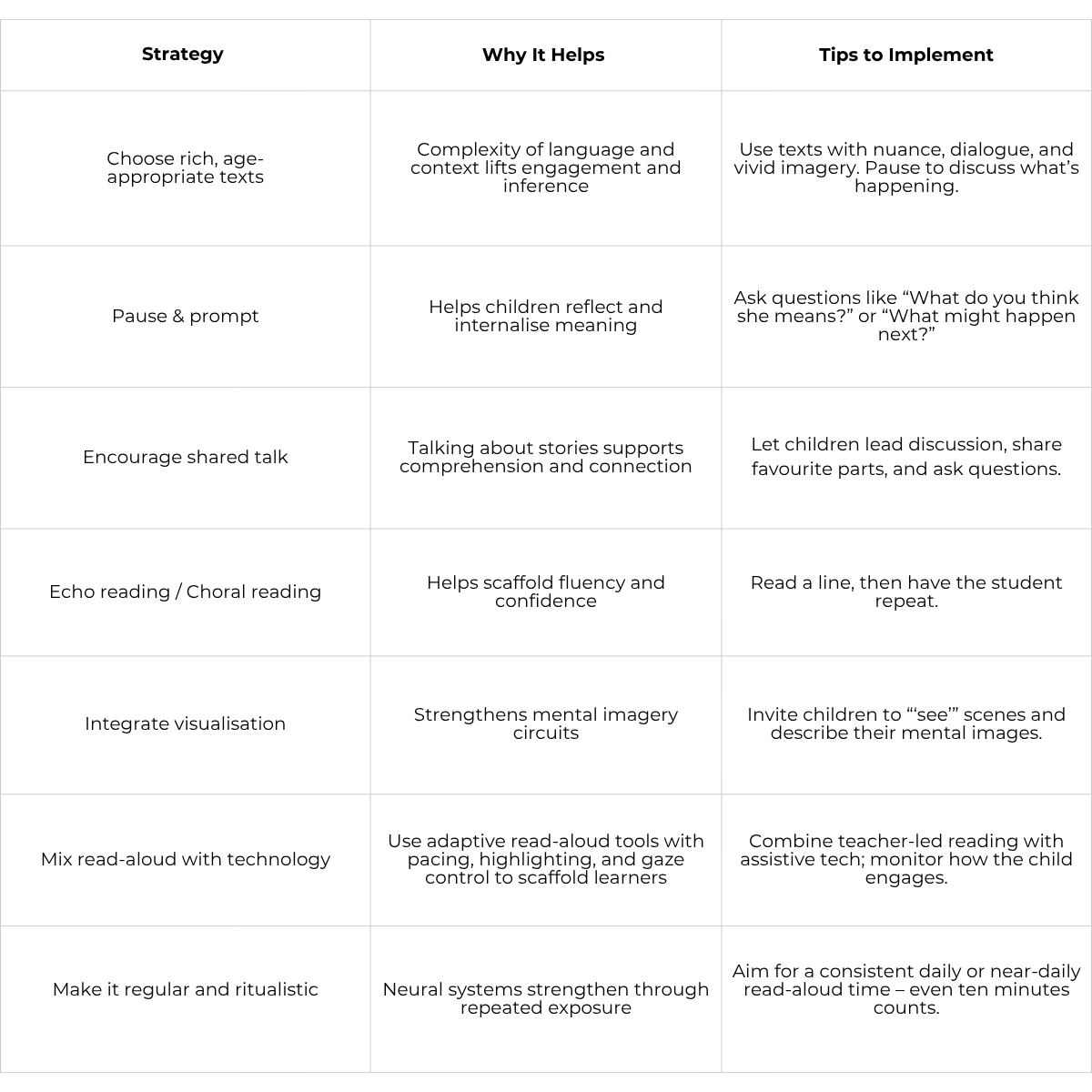
To maximise the brain-building benefits of reading aloud, here are strategies you can adopt:

The Role of Technology, and the Rise of ASR
As educational practice evolves, digital tools now play a significant part in making read-aloud more accessible and engaging. A key advancement is Automatic Speech Recognition (“ASR”) technology. ASR offers direct, real-time feedback as children read aloud, helping them refine fluency and accuracy independently. This proves invaluable for those children who may not have adult support at home, allowing them to build confidence through solo practice.

For teachers, ASR applications provide data and analysis regarding each child’s reading performance, helping guide in-class learning and allowing for targeted intervention. Many solutions also incorporate gamification badges, progress scores, and reading challenges – which serve to increase engagement and motivation in young readers.

Looking Ahead: Read-Aloud in a Changing World
For parents, reading aloud is a daily ritual that goes beyond story time. Only ten minutes of shared reading can boost a child’s confidence, imagination, and sense of connection. For teachers, it is a proven strategy to support comprehension, especially when layered with evidence-based practices and adaptive technologies now widely available in UK classrooms.

Digital platforms utilising ASR, now put these scientific principles into practice. Fonetti, for example, uses ASR to provide children with instant feedback on their reading, while engaging them through gamified rewards and progress tracking. This fusion of science and technology helps struggling readers build independence, without diminishing the human connection found in shared reading experiences.

The opportunity for both parents and educators lies in treating reading aloud not as an optional extra, but as a cornerstone of development. It is a practice that supports brain growth, literacy, and, ultimately, the life skills young people need to thrive in the ever-changing future.

Posted in Automatic Speech Recognition, Reading, Research, Technology

Literacy Skills Amongst English Adults Continue to Decline, OECD Study Reveals

In a world increasingly shaped by information, communication, and digital access, the ability to read with confidence and understanding is more essential than ever. Yet, the latest findings from the OECD’s Survey of Adult Skills (PIAAC) suggest that literacy among working-age adults in England is not improving – in fact, it’s getting worse.

The PIAAC study assesses the literacy skills of adults aged 16 – 65 across OECD countries, rating their reading ability on a scale from 0 to 5. A score of Level 3 is seen as the minimum required to meet the demands of everyday life – things like understanding workplace emails, navigating healthcare information, and interpreting official forms. Scoring Level 1 or below is considered to reflect very poor literacy, severely limiting someone’s ability to participate in society and the workforce.

This blog will delve into the latest set of results and what the implications are for working-age people, employers and society as a whole. But if you’d like to read the results for yourself, you can access them here: Survey of Adult Skills 2023: national report for England – GOV.UK

A Stagnant – or Slipping – Picture at the Top
In 2019, nearly half of working-age adults in England (49.47%) were assessed as being below Level 3. At the time, this raised alarm bells about how well the education system was preparing people for the demands of modern life.

Fast forward to the latest results in 2024, and the situation has not improved. In fact, the proportion has risen slightly to 50% – equivalent to an estimated 18.34 million adults lacking the literacy skills needed to confidently manage everyday tasks. This isn’t just a statistic. It’s a reflection of millions of people potentially struggling to:

  • Write clear emails or reports at work
  • Understand letters from their GP or local council
  • Help their children with homework
  • Access government services online

For businesses, it can mean decreased productivity, greater training needs, and communication barriers. For individuals, it can mean limited job opportunities, lower income, and reduced confidence.

A Worrying Rise in Very Poor Literacy
Even more concerning is the rise in adults scoring Level 1 or below – those with very poor literacy skills. In 2019, this group made up 16.36% of adults in England. In 2024, that figure has risen to 18% – representing around 6.6 million people. This level of literacy can mean struggling to:

  • Understand written safety instructions
  • Read a timetable or menu
  • Fill in a simple form
  • Follow medicine dosage information

For these adults, the barriers to employment, health, and full social participation are profound. The risk of social exclusion, long-term unemployment, and poor mental health is significantly higher.

Why This Matters – And What Fonetti Is Doing About It
These findings are more than a wake-up call – they are a clear indicator that literacy support must start early, and it must be sustained. At Fonetti, we believe that tackling the adult literacy crisis begins with how we teach children to read. Our platform uses Automatic Speech Recognition (ASR) technology to support children reading aloud – one of the most effective ways to build fluency, comprehension, and confidence. By offering real-time feedback and encouragement, Fonetti helps young readers develop strong literacy foundations before they fall behind. The OECD data makes one thing crystal clear: the cost of poor literacy is not just individual – it’s societal. But by investing in the right tools, delivered at the right time, we can change the trajectory for the next generation.

Let’s not wait for the next report to show us what we already know.

Let’s build a future where every child – and every adult – can read with confidence.

Posted in Literacy, Automatic Speech Recognition, News, Research

UK Children’s Reading Enjoyment Hits 20-Year-Low: A Wake-Up Call for Us All!

National Literacy Trust data from early 2025 paints an alarming picture – how Fonetti is stepping in to help

The National Literacy Trust (NLT) has just released its latest figures on children’s and young people’s reading habits for the first half of 2025. Based on responses from over 114,000 pupils across 515 UK schools, the findings are nothing short of concerning.

This data snapshot, covering the first five months of the year, reveals a continued and dramatic decline in both reading enjoyment and daily reading frequency among children aged 5 to 18. In this blog, we’ll summarise the report’s most worrying findings – and explain how at Fonetti, we’re working to reverse this trend using cutting-edge technology that makes reading not just a habit, but a joy.

You can access the full NLT report here: Children and young people’s reading in 2025 | National Literacy Trust

📚 1. Reading Enjoyment Continues to Fall
Perhaps the most distressing figure from this year’s report:

“Just 1 in 3 (32.7%) children and young people say they enjoy reading.”

This is the lowest figure recorded in two decades, representing a 36% decline in reading enjoyment since 2005.
Even more worrying is the steep drop in enjoyment among primary-aged children and boys aged 11 – 16; a group already at greater risk of falling behind in literacy. Reading for pleasure is strongly linked to academic success, emotional well being, and future life opportunities. When children stop enjoying books, we lose more than just reading time – we lose connection, curiosity, confidence, and a vital developmental tool.

📉 2. Reading Frequency is at an All-Time Low
The number of children who read daily in their free time is also plummeting. In 2025, fewer than 1 in 5 (18.7%) 8- to 18-year-olds said they read something every day outside school – the lowest level ever recorded by the NLT.

  • Among 5- to 8-year-olds, daily reading fell to 44.5% – a decline of 3.4 percentage points just since 2024.
  • The daily reading gap between girls and boys has widened to 6.2 percentage points – the biggest since 2023.
  • Children receiving Free School Meals (FSMs) are reading less frequently than their peers: 15.8% vs. 19.4%.

These aren’t just numbers. They’re warning signs. Children who aren’t reading daily – especially those in underserved communities – are more likely to struggle with reading attainment later in life.

🔊 3. How Fonetti Is Helping to Turn the Page
At Fonetti, we believe every child deserves the joy of reading – and the confidence that comes with it. We also know that traditional approaches aren’t working for every child. That’s why Fonetti harnesses Automatic Speech Recognition (ASR) to bring reading to life in a whole new way. With Fonetti, children read aloud to their device – and the app listens, understands, and encourages them in real time. This not only builds fluency and comprehension, but also restores the sense of pride and fun that should come with reading.

What makes our approach different?

  • Instant feedback – boosts confidence and motivates kids to keep going
  • Gamified experiences – make reading feel like play, not homework
  • Parental and teacher dashboards – track progress and celebrate milestones
  • We reach children who might not otherwise enjoy reading – from reluctant readers to those with learning differences

Our mission is to reignite reading enjoyment and improve literacy outcomes for every child, no matter their background or reading level.

🛑 It’s Time to Act
The latest data is not just a wake-up call – it’s a call to arms. The UK is facing a literacy crisis, and it’s our responsibility as educators, parents, and tech innovators to respond with urgency and creativity. At Fonetti, we’re committed to using the power of voice, technology, and joyful design to help more children fall in love with reading again.

We invite you to be part of the solution.

📲 Learn more about Fonetti and how it supports children’s reading:
www.fonetti.com

Posted in News, Automatic Speech Recognition, Research

How Reading Aloud Can Develop Language Comprehension

Part 2 of a two-part series on the Simple View of Reading.

When we think about helping children learn to read, it’s easy to focus only on outcomes – how many books they finish, how well they can read aloud in front of others, or how soon they become “independent” readers. But before we can talk about progress, it’s important to understand what reading actually involves.

That’s where the Simple View of Reading comes in.

Originally proposed by researchers Philip Gough and William Tunmer in 1986, the Simple View of Reading is the model that underpins the National Curriculum in England today. It breaks reading down into two core components:

  • Decoding (or word reading) – the ability to identify and pronounce words using knowledge of letters and sounds.
  • Language comprehension – the ability to understand what those words and sentences actually mean, in context.

Children need to be proficient in both of these areas to become confident, capable readers. Without decoding, they can’t read the words; without comprehension, the words have no meaning. You can think of it as a simple equation:

Reading = Decoding × Comprehension

If either skill is missing (or weak), reading breaks down.

In this two-part blog series, we’ll explore both elements of the Simple View of Reading and how reading aloud can support children’s development in each. In last week’s blog we discussed decoding – also known as word reading. This week we turn our attention to Language Comprehension.

Understanding language comprehension
To put it simply, Language comprehension is the ability to understand the words, sentences and the wider context of what we are reading or hearing. It is essentially to derive meaning from what we are reading or hearing.

How Reading Aloud Supports Language Comprehension: Bridging the vocabulary gap
Before children begin learning to read for themselves, their understanding of language is largely developed through speaking and listening. These early interactions help them build vocabulary, understand how words fit together, and begin to recognise the patterns of language.

But not all children have the same early experiences. For those growing up in language-poor environments – where adult conversation is limited in quality or quantity – their exposure to new vocabulary can be significantly reduced. This difference is commonly referred to as the word gap, and studies have estimated that by the time children start school, this gap can amount to tens of millions of words [5].

The gap isn’t just about spoken language – it also shows up in reading habits. A study by researchers at Ohio State University found that children in households where books were read aloud regularly had heard around 1.4 million more words by the age of five than those whose parents read to them only occasionally [35].

This early deficit in vocabulary and language exposure can have long-term effects. Recognising this, the 2021 reforms to the Early Years Foundation Stage highlighted the need to support children from language-poor homes by increasing their access to high-quality spoken language experiences [36].

Reading aloud is a powerful way to do just that. Unlike silent reading, it models pronunciation, rhythm, and sentence structure, while also encouraging active engagement and listening. Most importantly, it supports the development of speaking skills, helping children use and internalise vocabulary they may not have encountered at home.

Reading aloud vs reading silently – the impact on retention and recall
Language comprehension isn’t just about understanding a word once – it’s about being able to retain and recall it when needed. These are essential building blocks for more advanced reading comprehension.

Research shows that when children read aloud, they are significantly more likely to remember what they’ve read than when they read silently [37 – 40]. One study involving children aged 7 – 10 found that participants correctly recognised 87% of words they read aloud, compared to just 70% of those read silently [40].

This difference is explained by what psychologists call the “production effect” [37]. Reading aloud involves two distinct and reinforcing processes:

  • An active motor act – speaking the word
  • A self-referential auditory input – hearing themselves say it

Together, these processes make new words more memorable. In fact, even whispering, mouthing, or writing the words out can help improve recall compared to reading silently, because these methods all engage additional sensory or motor pathways [39].

So if the goal is to build comprehension through vocabulary retention, reading aloud wins hands down.

Oral language and comprehension go hand-in-hand
The benefits of reading aloud go beyond memory. The Education Endowment Foundation (EEF), in their guidance on improving literacy in Key Stage 1, highlight the importance of explicitly developing children’s speaking skills as part of improving reading comprehension [41].

Reading stories aloud – whether by an adult or the child themselves – provides valuable opportunities for conversation. Children can ask questions, make predictions, and reflect on what they’ve read, all of which help deepen their understanding of the text. This is supported by research into interventions for children with reading difficulties. One study found that children who participated in oral language training made the greatest gains in reading comprehension, compared to those using other types of intervention [42].

Reading aloud encourages children to process language more deeply, make connections between spoken and written language, and practise using new vocabulary in context – all essential components of strong comprehension.

Final Thoughts
When we think about reading aloud, we often picture young children cuddled up with picture books. But its benefits extend far beyond the early years. Whether it’s a five-year-old learning the rhythm of language or a ten-year-old building vocabulary through complex narratives, reading aloud remains one of the most powerful tools we have to support language comprehension. And since comprehension is one half of the Simple View of Reading equation, that makes reading aloud essential – not optional – for every child learning to read.

So let’s keep the stories flowing. Let’s read aloud, every day, to give every child the language foundation they deserve.

Posted in Reading, Insights, Research

How Reading Aloud Can Develop Decoding Skills (Word Reading)

Part 1 of a two-part series on the Simple View of Reading

When we think about helping children learn to read, it’s easy to focus only on outcomes – how many books they finish, how well they can read aloud in front of others, or how soon they become “independent” readers. But before we can talk about progress, it’s important to understand what reading actually involves.

That’s where the Simple View of Reading comes in.

Originally proposed by researchers Philip Gough and William Tunmer in 1986, the Simple View of Reading is the model that underpins the National Curriculum in England today. It breaks reading down into two core components:

  1. Decoding (or word reading) – the ability to identify and pronounce words using knowledge of letters and sounds.
  2. Language comprehension – the ability to understand what those words and sentences actually mean, in context.

Children need to be proficient in both of these areas to become confident, capable readers. Without decoding, they can’t read the words; without comprehension, the words have no meaning. You can think of it as a simple equation:

Reading = Decoding × Comprehension

If either skill is missing (or weak), reading breaks down.

In this two-part blog series, we’ll explore both elements of the Simple View of Reading and how reading aloud can support children’s development in each. Today, we start with decoding – also known as word reading.

Understanding Decoding (Word Reading)
Before jumping into the benefits of reading aloud, let’s take a moment to understand what decoding actually means. In simple terms, decoding refers to a child’s ability to read unfamiliar words by sounding out letters and blending those sounds together – either silently or aloud. To do this successfully, children must be explicitly taught how letters (or ‘graphemes’) correspond to particular sounds (‘phonemes’).

With enough practice, children begin to recognise and decode familiar words automatically, without needing to sound them out each time. But getting to that point takes both structured phonics instruction and regular practice.

How Reading Aloud Supports Decoding Skills: The Synthetic Phonics Programme
When children first learn to read in Key Stage 1, they are taught how to decode words through a synthetic phonics programme. (‘Synthetic’ in this context means to combine – synthesising letter sounds into words.) This involves learning the phonemes that match each grapheme and how these can be blended to form words.

Phonics instruction has been hugely successful: 89% of pupils met the expected standard in the Phonics Screening Check by the end of KS1 in 2023. However, while reading aloud can’t replace phonics teaching, it can play a significant supporting role. Reading aloud:

  • Exposes children to phonics in varied contexts.
  • Reinforces sound-letter recall through repetition.
  • Encourages children to produce sounds themselves – not just hear them.

This active vocalisation helps strengthen the brain’s connection between letters and sounds, which is vital when children come across new or unfamiliar words. Importantly, this benefit extends to children with learning difficulties like dyslexia. Studies show that reading aloud – through articulation and prosody – makes reading a multi-sensory task. Hearing themselves read allows dyslexic students to self-correct in a way that doesn’t typically happen during silent reading.

So, when reading aloud is combined with a phonics programme – and the chosen texts match the child’s current phonic knowledge – it can significantly boost progress, especially ahead of the Phonics Screening Check in Year 1 or 2.

From Decoding to Fluency
Once decoding becomes more automatic, children begin to develop reading fluency – often described as the bridge between decoding and comprehension. A fluent reader can read accurately, at an appropriate pace, and with expression (prosody). Reading aloud is one of the most effective ways to build fluency. It helps children:

  • Hear and adjust their reading speed to avoid stumbling or skipping.
  • Engage with punctuation (e.g., pausing at full stops).
  • Practise using stress and intonation, making reading more expressive and engaging.

According to the Standards and Testing Agency, around 90 words per minute is a key fluency benchmark by the end of KS1 – and reading aloud can help children reach that goal.

As children become more fluent, they also tend to enjoy reading more – and children who enjoy reading are more likely to read frequently. It’s a virtuous cycle.

Beyond Reading: Oracy and Confidence
Reading aloud doesn’t just support decoding and fluency – it also develops oracy skills, defined as “the development and application of a set of skills associated with effective spoken communication.” These skills are not only vital for success in school, but they are increasingly valued in the workplace too.

Reading aloud gives children the chance to practise spoken communication alongside their reading skills – a benefit that silent reading simply doesn’t offer. For teachers, it’s also a practical way to encourage oracy practice outside the classroom, particularly for children from language-poor households or with lower language skills. Teachers have consistently identified pupils with English as an additional language (73%), disadvantaged pupils (71%), and pupils with low attainment (68%) as the groups who would benefit most from increased speaking activities. Reading aloud offers a simple but effective intervention.

And finally, there’s confidence. For many children, speaking or reading in front of others can be daunting – especially if they struggle with reading. A drop in reading confidence has been noted in recent years, falling to just 45% in 2021. Reading aloud in a safe, private space – whether at home or in a supportive classroom setting – gives children a chance to build confidence in their own time. Over time, this can reduce anxiety, boost self-esteem, and prepare them to participate more actively in school oracy-based activities.

In Summary
While a strong phonics programme lays the foundation for decoding, reading aloud brings that learning to life – helping to embed phonics knowledge, build fluency, strengthen oracy, and boost confidence. It turns reading into a multi-sensory, engaging, and empowering experience.

In next week’s blog, we’ll explore how reading aloud can also support the other half of the Simple View of Reading: language comprehension. Stay tuned.

Posted in Reading, EAL, Insights, Research

Fact Check: Are English Readers Really the Best in the Western World?

It was a claim repeated again and again during the 2024 general election campaign by the Conservative Party. In this blog, we’ll take a closer look at the data behind the claim and assess whether it really stacks up.

The Claim: “English children are the best readers in the western world”

The Answer: Technically Yes, But Really No

Let us explain…

This claim refers to results from the latest iteration of the Progress in International Reading Literacy Study (PIRLS) conducted in 2021. PIRLS is a standardised assessment that measures the reading ability of 10-year-olds across the globe. The 2021 study assessed nearly 400,000 pupils in 57 countries, despite widespread disruption caused by the Covid-19 pandemic. PIRLS focuses on three key aspects of reading literacy:

  • How pupils read different types of texts;
  • The reading comprehension strategies they use;
  • Their attitudes towards reading.

Technically Yes…
In the 2021 PIRLS results, England ranked fourth out of 43 countries, with an average reading score of 558. This was behind only Singapore (587), Hong Kong (573), and Russia (567). This result means that England outperformed every other European or North American country. In this sense, English 10-year-olds were the highest scorers in the western world according to the 2021 PIRLS study.

So when former Prime Minister Rishi Sunak MP, current Leader of the Opposition Kemi Badenoch MP, and others in the Conservative Party say England has the best young readers in the western world, they are technically correct – at least according to this one study.

However, There’s a Big Asterisk
England moved up from joint 8th place in the 2016 PIRLS study to 4th in 2021. While this might seem like a success story, the leap is likely explained by data collection anomalies linked to the pandemic. In fact, the Department for Education (DfE) itself urged caution when comparing England’s results with other countries in this edition. Here’s why…

England Delayed Its Testing by One Year
Due to the pandemic, England postponed its PIRLS data collection by a full academic year – testing pupils in 2021 – 22 instead of 2020 – 21, as most other countries did. This meant England’s pupils avoided the worst disruption to schooling caused by Covid-19.

According to a 2021 Ofqual report, primary school teachers identified reading and phonics as the areas of learning most negatively impacted by pandemic-related disruptions. So, it’s fair to say that testing children a year later gave England a notable advantage.

While we can’t say exactly how England would have scored if tested on schedule – or how other nations might have performed if they’d waited too – it’s worth noting that 7 of the 9 countries who previously scored higher or equal to England in 2016 did test during the pandemic peak, likely contributing to their drop in scores. Reflected by the sharp 19 points drop in the international median score between 2016 and 2021.

Other Countries Were Disqualified from the Leaderboard
Fourteen education systems – including the USA, Ireland, and Northern Ireland – chose to delay their PIRLS testing by around six months. As a result, they assessed slightly older students and were disqualified from the official leaderboard for not following the standard protocol.

This is significant. Both Ireland and Northern Ireland, which historically outperform England in PIRLS, scored 19 and 8 points higher than England in 2021 – but were disqualified from the official leaderboard due to testing an older cohort of pupils. Had they tested on schedule, they might still have ranked above England.

So while England’s “top of the West” title is technically valid, it’s due in large part to having avoided the worst of the pandemic’s educational fallout and because several stronger-performing countries were excluded from the rankings. In short, any claim that England’s 10-year-olds are the “best readers in the western world” should come with a large asterisk – and a dose of caution.

The Real Problem With the Claim
Yes, politicians are technically entitled to make this claim based on the 2021 PIRLS results. But the real danger lies in how it’s received. If people believe England’s reading education is world-leading, they may conclude that no further action is needed to support children’s reading development.

This couldn’t be further from the truth

A Look at Long-Term Trends

  • England’s PIRLS Scores Over Time:
    • Despite moving from 19th in 2006 to 4th in 2021, England’s average score (558) hasn’t changed much in two decades. It was 553 in 2001, 552 in 2011, and 559 in 2016. In other words, we’ve stayed fairly static in terms of actual progress.
  • England’s PISA Scores Over Time:
    • England also improved its position in the OECD’s Programme for International Student Assessment (PISA) for 15-year-olds – from 25th in 2009 to 12th in 2022. But the average reading score in 2022 (496) was lower than in 2012 (500), 2015 (500), and 2018 (505) and similar to 2006 (496) and 2009 (495).
  • Key Stage 2 Standards:
    • In 2023/24, 26% of Year 6 pupils – about 170,640 children – did not meet the expected reading standard. That means over a quarter of pupils are entering secondary school without the literacy skills they need.
  • Declining Reading Enjoyment and Frequency:
    • 2024 saw the lowest levels of reading enjoyment and frequency since records began. Just 34.6% of children said they enjoyed reading – a drop of 8.8 percentage points from 2023. Only 20.5% read daily, down almost 50% compared to two decades ago.

And this matters: children who enjoy reading and do it frequently are significantly more likely to become skilled readers.

Conclusion: Why the Real Reading Challenge Still Lies Ahead
So, are English readers really the best in the western world? On paper, maybe. But the 2021 PIRLS results don’t tell the full story, and they certainly shouldn’t lead us to complacency. Literacy progress in England has stagnated, and too many children are still leaving primary school without the reading skills they need.

At Fonetti, we believe that every child deserves not just to learn to read but to love reading. That’s why we’re working to make reading accessible, engaging, and empowering – especially for those who need it most. By using voice recognition to support and reward children as they read aloud, Fonetti helps build fluency, confidence, and a genuine love of books.

We don’t just want England to rank well on global leaderboards – we want every child in the UK to feel like the best reader in the world. And that’s a challenge worth tackling.

Posted in Insights, Reading, Research