
Tech in the Early Years: Striking the Balance Between Play, Print and Pixels

Why balance matters
Young children learn best through rich, hands-on, play-based experiences, and technology is now simply part of the world they are growing up in. Thoughtfully used, digital tools can complement they are not a replacement to traditional play and print. They can support language development, creativity and early literacy when adults stay actively involved. For both parents and early year educators, the goal is not striving for “no screen time” but “better screens”. Used in the right measure and for the right reasons, it supports confident advancement without creating dependency.

What research says about tech and print
UK guidance for early years emphasises limiting sedentary screen time and prioritising movement and social interaction, especially under age 5. For 2 – 4 year olds, recommendations suggest no more than about an hour of sedentary screen time per day, and less is better when that time displaces sleep, physical play or face-to-face connection.

Studies also show a “print advantage”: children often focus more deeply and understand stories better when reading from physical books, with higher activity in attention-related areas of the brain compared to screens. Print brings additional benefits such as tactile engagement, freedom from notifications and reduced eye strain, all of which support early readers’ concentration and enjoyment.

Principles for healthy digital use (Early Years Foundation Stage)
For early primary and EYFS, three principles help keep technology in its place: purpose, participation and proportion.

  • Purpose: Choose digital tools that clearly support language, early literacy, creativity or communication, rather than passive entertainment.
  • Participation: Aim for co-use adults and children explore together rather than children using devices alone for long stretches.
  • Proportion: Protect sleep, outdoor play, print books and social interaction first, then fit short, high-quality digital sessions around those foundations.

Play first, pixels second
Play remains the “engine” of learning in the early years, building everything from motor skills and coordination to language, problem-solving and self-regulation. Open-ended play with blocks, role-play, drawing, sand, water and outdoor exploration provides sensory and social experiences no app can replicate and should anchor the day in homes and classrooms.

Digital tools can join this play, rather than interrupt it. For example, children might photograph a block model, record themselves telling a story about it, or use a simple app to capture and replay their own narration, blending physical making with digital meaning-making.

The unique power of print
For young readers, physical books offer a calm, predictable space where adults and children can slow down together. Shared print reading encourages turn-taking, pointing, talk about pictures and story prediction, all of which feed vocabulary and comprehension. Because print books are free from in-app rewards and notifications, they naturally encourage longer attention spans and deeper emotional connection with characters and ideas. For many families, bedtime print reading also becomes a cherished routine that supports attachment and language development at the same time.

Print will always have a unique role in family reading, but well‑designed digital books can sit alongside it, especially when they encourage children to read aloud, interact with the story and share their progress with adults.

When pixels help: high-quality literacy apps
Not all screen time is equal. High-quality literacy apps designed around active engagement, feedback and language-rich content can support early readers, especially when access to adult one-to-one time or physical books is limited. Tools that encourage children to read, speak, listen and respond rather than just swipe and watch align more closely with early years pedagogy.

An interactive experience allows children in early primary years to practise decoding and reading aloud in short, focused bursts, while parents and teachers gain insight into reading frequency and progress through built-in reporting.

Practical ideas for EY educators
In nurseries and early primary classrooms, technology can sit alongside print corners, construction areas and role-play spaces rather than as a standalone “ICT treat.”

  • Create a reading ecosystem: Combine a cosy print book corner with a small digital station where children can record themselves reading or use an app like Fonetti for short, timetabled reading practice.
  • Blend physical and digital: Invite children to draw storyboards on paper, then read and record their stories using a tablet, linking concrete mark-making to digital publishing.
  • Use data to target support: Use literacy apps’ reporting to identify children who need extra support with fluency, then follow up with print-based small-group work and adult-led reading.
  • Co-construct rules: Involve children in agreeing how, when and why devices are used in the setting, building digital citizenship from the earliest years.

Comparing play, print and pixels

A balanced reading diet
For early primary years, thinking of a “reading diet” can help lots of play and print as the main course, and carefully chosen pixels as a powerful side dish. Print stories and real-world playground children in language, relationships and imagination, while digital tools can boost confidence, provide extra practice and make progress visible in ways that motivate both children and adults. When parents and educators collaborate on clear routines, shared expectations and open communication, technology becomes an ally in building lifelong readers rather than a competing distraction.
Posted in Reading, EdTech, Insights, Technology

The Science of Reading Aloud: Why It Builds Brains Beyond Literacy

When we think of reading aloud, we often see it as a stepping stone to helping children with vocabulary, fluency, and comprehension. Increasingly, research shows that its impact reaches much further. Reading aloud not only builds readers, it also promotes brain development. From memory to social understanding, and from confidence to connection, this simple habit brings lifelong benefits.

How Reading Aloud Shapes the Brain

  1. Boosts Memory – Speaking words out loud improves recall, a phenomenon known as the production effect. By seeing, saying, and hearing words, children create stronger memory traces than through silent reading alone.
  2. Strengthens Neural Connections – Reading aloud engages multiple systems at once: vision, speech, hearing, and language comprehension. This multi sensory workout reinforces the links between brain regions, building foundations for focus, problem-solving, and flexible thinking.
  3. Supports Comprehension for Struggling Readers – For children who find decoding difficult, hearing text read aloud provides a framework for understanding. Assistive technologies, now used in many UK classrooms, show that combining audio with visual text can raise comprehension and confidence.

Benefits Beyond Literacy
Reading aloud helps children develop skills that extend well beyond the classroom:

  • Attention and focus: Following along encourages concentration.
  • Imagination: Stories stimulate mental imagery and creative thinking.
  • Empathy and perspective: Hearing stories deepens emotional understanding.
  • Confidence and independence: Shared reading empowers children to engage with texts they might find challenging alone.
  • Stronger relationships: Reading together nurtures bonds between children, parents, and teachers.

Practical Strategies for Parents and Teachers
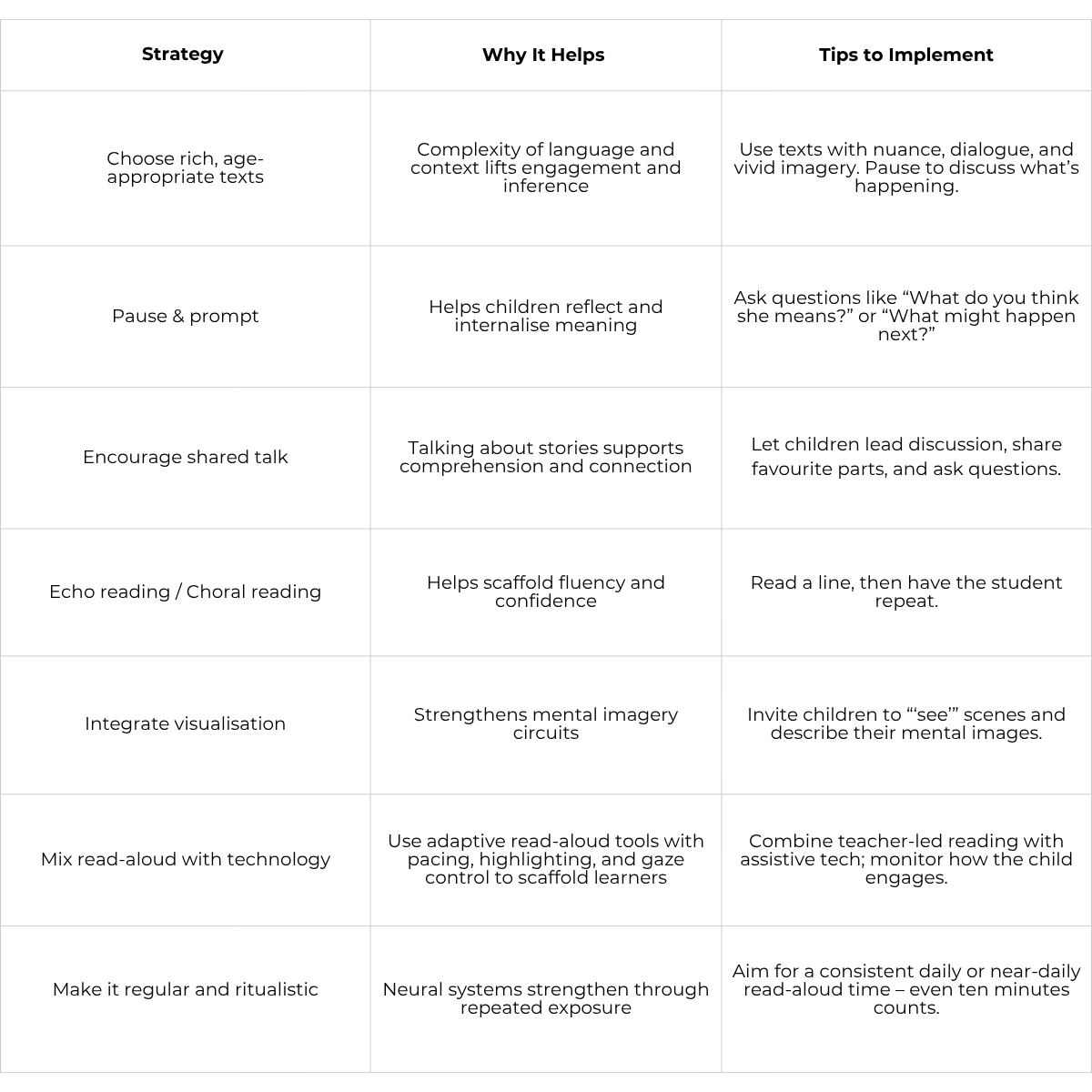
To maximise the brain-building benefits of reading aloud, here are strategies you can adopt:

The Role of Technology, and the Rise of ASR
As educational practice evolves, digital tools now play a significant part in making read-aloud more accessible and engaging. A key advancement is Automatic Speech Recognition (“ASR”) technology. ASR offers direct, real-time feedback as children read aloud, helping them refine fluency and accuracy independently. This proves invaluable for those children who may not have adult support at home, allowing them to build confidence through solo practice.

For teachers, ASR applications provide data and analysis regarding each child’s reading performance, helping guide in-class learning and allowing for targeted intervention. Many solutions also incorporate gamification badges, progress scores, and reading challenges – which serve to increase engagement and motivation in young readers.

Looking Ahead: Read-Aloud in a Changing World
For parents, reading aloud is a daily ritual that goes beyond story time. Only ten minutes of shared reading can boost a child’s confidence, imagination, and sense of connection. For teachers, it is a proven strategy to support comprehension, especially when layered with evidence-based practices and adaptive technologies now widely available in UK classrooms.

Digital platforms utilising ASR, now put these scientific principles into practice. Fonetti, for example, uses ASR to provide children with instant feedback on their reading, while engaging them through gamified rewards and progress tracking. This fusion of science and technology helps struggling readers build independence, without diminishing the human connection found in shared reading experiences.

The opportunity for both parents and educators lies in treating reading aloud not as an optional extra, but as a cornerstone of development. It is a practice that supports brain growth, literacy, and, ultimately, the life skills young people need to thrive in the ever-changing future.

Posted in Automatic Speech Recognition, Reading, Research, Technology

The Great Screen Time Debate: Positive or Harmful?

Navigating the Digital World with Your Children

When it comes to children and screen time, opinions and research findings are varied, reflecting both potential benefits and risks. Here’s a breakdown of what people generally say about the topic and the difference between positive and harmful screen time.

General Opinions and Research Findings:

  1. Concerns About Overuse:
    • Health Risks: Excessive screen time has been linked to issues like obesity, poor sleep quality, eye strain, and increased risk of mental health issues such as anxiety and depression.
    • Developmental Concerns: There’s concern that too much screen time, especially passive consumption (e.g., watching TV), may impede the development of social skills, language acquisition, and creativity in younger children.
  2. Potential Benefits:
    • Educational Content: Well-designed educational apps and programs can support learning, particularly in areas like literacy, numeracy, and critical thinking. Interactive content, in particular, can engage children in ways that traditional methods may not.
    • Social Connection: Screen time can help maintain social connections, especially for older children and teenagers. Social media, messaging apps, and video calls can be important for social interaction, particularly when in-person interaction is limited.
    • Skill Development: Certain types of screen time, such as playing strategy-based video games, can enhance cognitive skills like problem-solving, hand-eye coordination, and multitasking abilities.

Positive vs. Harmful Screen Time:

  1. Positive Screen Time:
    • Educational and Interactive Content: Content that encourages interaction, creativity, and learning is considered positive. Educational games, documentaries, and apps that teach skills or subjects are examples of beneficial screen time.
    • Limited and Purposeful Use: When screen time is limited to specific times and purposes, it’s more likely to be beneficial. For instance, using screens for homework, research, or connecting with family members is generally seen as positive.
    • Co-viewing and Parental Involvement: When parents are involved in their child’s screen activities, it can lead to more meaningful experiences. Co-viewing and discussing content can enhance understanding and make screen time more interactive.
  2. Harmful Screen Time:
    • Excessive Use: When screen time is not regulated, and children spend excessive hours in front of screens, it can lead to negative physical and mental health outcomes.
    • Passive Consumption: Consuming content passively, such as binge-watching shows or aimlessly scrolling through social media, is often considered harmful. This type of screen time can displace physical activity, reduce sleep quality, and limit real-life social interactions.
    • Exposure to Inappropriate Content: Without proper supervision, children may be exposed to content that is not age-appropriate, which can have negative effects on their development and behaviour. This includes violent video games, inappropriate websites, or social media content that may be harmful.
    • Impact on Attention Span and Academic Performance: There’s evidence suggesting that excessive screen time, particularly with fast-paced and overstimulating content, may negatively impact attention spans and academic performance.

Conclusion:
The conversation around children and screen time is nuanced. While there are clear risks associated with excessive and unregulated screen use, there are also potential benefits when screen time is balanced, purposeful, and involves high-quality, educational content. The key is moderation and ensuring that screen time is just one of many activities in a child’s daily life. Parental guidance and involvement are crucial in navigating the digital world safely and effectively.

At Fonetti, we understand the challenges parents face in navigating the world of screen time. That’s why we’re committed to providing interactive, educational content that makes learning fun and engaging for your child.

Explore our platform today to discover how screen time can be a positive force in your child’s education and development.

Posted in EdTech, Insights, Research, Technology

How EdTech Is Transforming the Classroom

The use of technology in education has become increasingly popular in recent years, as more and more schools are incorporating it into their curriculum. From interactive whiteboards to educational apps, there are endless possibilities for how technology can enhance learning experiences.

Let’s dive into a few of the many advantages that arise when educational technology (ed tech) is seamlessly integrated into schools. 

Enhancing Teaching and Learning
One of the most significant benefits of using educational technology is its ability to enhance teaching and learning. With the use of digital tools, teachers can create interactive and engaging lessons that capture students’ attention and interest. Such lessons allow for a more dynamic learning experience, making it easier for students to retain information.

Moreover, technology provides teachers with a wide variety of resources and materials to supplement their lessons. With access to online educational platforms, teachers can find a vast array of videos, simulations, and other interactive content to enrich their teaching. This diversity of resources allows for more personalised learning experiences that cater to students’ specific needs and learning styles.

Promoting Self-directed Learning
Another advantage of educational technology is its ability to promote self-directed learning. With access to online resources, students can take control of their education and explore topics that interest them beyond the traditional curriculum. This not only allows for a more personalised learning experience but also encourages students to take ownership of their education and develop critical thinking skills.

Moreover, technology provides students with the opportunity to learn at their own pace. With access to recorded lessons, online tutorials, and other digital resources, students can revisit concepts they find challenging without feeling rushed or left behind.

Preparing Students for the Future
As technology continues to advance, it is becoming increasingly important for students to be equipped with digital literacy skills. By incorporating educational technology into schools, students can develop these skills and be better prepared for the future workforce.

Moreover, with the use of online learning platforms and resources, students can also gain experience in using various tools and technologies commonly used in different industries. This exposure allows them to develop a better understanding of how technology can be applied in real-world scenarios.

The BETT Awards, also known as the British Educational Training and Technology Awards, is an annual event that celebrates the use of technology in education. The purpose of the BETT Awards is to showcase innovative products and services that improve teaching and learning outcomes. It also aims to recognise the efforts of educators, schools, and organisations in using technology to enhance education.

BETT is one of the biggest events in the year for Fonetti and we are delighted to be nominated for the Class Aid & Educator award. Our revolutionary approach to reading has been proven to improve reading fluency and confidence in children as well as providing teachers with vital information and saving them time in the classroom. 

We are eagerly anticipating the upcoming event, eagerly waiting for the chance to connect with the remarkable individuals behind the extraordinary educational technology products being presented. From innovative learning platforms to cutting-edge digital tools, this event promises to showcase the latest advancements in the field. We cannot wait to engage in insightful conversations, gain valuable insights, and explore opportunities for collaboration. It’s an event that promises to inspire and ignite our passion for educational technology.

Posted in EdTech, Awards, Insights, Technology

Why We Need to Protect Children’s Reading Data

In today’s digital world, data is power. As individuals, we keep significant information online, from personal to financial details. However, regarding children’s data, we should be more cautious as children are not so security-minded, so they might add personal information that could put them at risk. Schools, online education, and gaming applications deal extensively with child data. However, as technology advances, we must be mindful of the more profound risks now posed involving voice recognition (VR) and how the data is protected.

In this blog post, we will explore the importance of protecting children’s data and three reasons why it should be a significant concern to everyone.

Firstly, VR technology poses many risks we must be aware of. Many VR apps and toys interact with children, interpret their speech patterns, and react accordingly, frequently recording and storing what is said. However, as the child befriends the app/toy or uses it in a family environment, the child might divulge personal information or feelings, plus discussions by parents in the background could all be captured by the system and be used to exploit the family, either through social engineering, phishing attacks, or worse still direct contact with the intent to blackmail.

Secondly, all data has value, and as children increase their use of technology for education and fun, more data is being gathered and stored. Hackers thus target companies who offer such applications to steal and use the data themselves but more frequently sell it on the dark web to multiple hackers, meaning families could be a target for numerous attacks with the potential of significant financial impacts. It is vital, therefore, that developers and owners of applications are cyber-aware and build into their systems robust data security procedures and techniques to minimise the risk of data theft. Parents and schools must ensure that their children’s privacy is adequately protected and take the time to check if the intended application is operated by a trusted organisation, and specifically for schools, they should conduct a Data Protection Impact Assessment (DPIA) as recommended by the Information Commissioner’s Office (ICO) to verify an application or service has taken steps to protect the data stored by them. Parents can also use this requirement to check an application, as frequently, within the organisation’s website, they will outline their DPIA compliance facts.

Thirdly, data protection is an essential legal requirement outlined in the General Data Protection Regulation (GDPR). Children’s data falls under “special categories” of personal information, which means there are strict regulations concerning how that data can be collected, processed, used, or stored. Failure to comply with these regulations can lead to hefty fines. Therefore, schools, app service providers, etc., responsible for dealing with children’s data, including their voices, must ensure adequate protection measures are in place to meet this regulation. It is wise to check a company’s GDPR statement for any new application you are considering for your children to reassure yourself that the organisation follows these rules, especially about data sharing.

Our Position on Data Security
At Auris, we take the security of our data very seriously. We designed our system to keep children safe on our platform. So our first step was to store the child’s voice recordings only if we had the specific consent of the parent or custodian. In these situations, the recordings are never linked to the child and are anonymous to our internal processes, but they still allow the parent or custodian to delete the recordings at any time should they wish. Finally, we encrypt all data so that even if a hacker were to gain access to it, they would not be able to read or use it as they would not hold the key to decipher it.

These measures mean our platform is robust and meets all the requirements of compliance and best practices for cyber security. It is the benchmark that others should be taking in protecting their digital assets. But we also recognise that we must be bold and that protecting data is a journey, not a one-time fix, so we will continue to enhance our service to meet the new challenges hackers present.

In Summary
As the digital landscape grows, it is essential to consider the safety and protection of children’s data. Parents, teachers, and other individuals responsible for caring for children should be mindful of the risks involved in voice recognition technology, cybersecurity risks, and GDPR. As technology advances, so must we in safeguarding the data of children. Becoming more proactive in protecting children’s data from cybercriminals and other malicious organisations is crucial. Data protection regarding sensitive personal information collected through online resources is not something to take lightly. At Auris, we understand that well.

Posted in Technology, Insights, Reading

Literacy Crisis is the Greatest Threat to Our Children After Covid-19

Over the Easter Weekend The Times ran an article Boris Johnson fears Lockdown illiteracy surge reporting the number of children struggling with literacy, as a result of lockdown learning, is rising by 30,000 over the past year.

If that’s not shocking enough, according to unpublished government figures revealed this week, more than 200,000 primary school pupils could make the transition to secondary school without the adequate literacy skills for their age. Many will not be able to read properly. It’s reported this will be Boris Johnson’s top priority after the coronavirus vaccination programme. The Government is expected to unveil a new four-year ‘emergency plan’ in May as a direct response. This could include after-school and holiday clubs as well as small group tutoring. But is manpower enough to solve this?

The solution is digital learning
It’s estimated that English students have lost more than 800 million teaching hours due to the pandemic. While those hours cannot be recouped instantly, independent digital learning can play a huge part in supporting the nation’s primary school pupils. As founder and CEO of Auris Tech, voice tech for literacy in the UK and English language learning, I understand the vital role technology plays in our schools. You can reach more children with technology. There’s no way reading can get back on track without it. Technology is the greatest way to reach people – as a leveller.

And the pandemic has proved that. Not just in education and the academic sector but in business in general. You only have to ask business leaders who led the IT strategy in their company? Was it their Chief Tech Officers, CEO or Covid-19? The answer will be the latter. Collaboration tools have supported businesses globally throughout this pandemic. Zoom has become a verb as well as one of the most used apps in lockdown, (increasing its profits by 400 percent*) with Microsoft Teams, Yammer and Google Classrooms being other go-to functions to keep schools and businesses connected. The digital realm has been a life-line and it will continue to be for many years to come.

If digital platforms are the foundation of future learning, smart technology applications are the perfect partners to guarantee success. Digital learning with smart AI and safe technology is a recipe for success. It provides a level playing field to all pupils, not just those within a radius of a school ranked as ‘excellent’. Schools simply don’t have the people power to offer 121 tuition for every child without technology. Accessibility is key to learning and indeed to literacy. The Government has made a massive in road to schools with technology but they need to install the right smart tech to guarantee success. The Hungry Little Minds campaign is just one example of this.

Reading is a foundation to learning. It’s a building block for every other academic subject and it’s essential in providing key skills for life. Confidence in our children is at an all time low as a result of the pandemic. Many children have had limited verbal interaction with their peers and these communicative skills can all be boosted through independent digital learning, as can vital life skills. Children are very comfortable with technology. Primary school pupils in particular are digitally native and expect technology to play a part in their lives.

Connecting communities
Throughout the pandemic there have been some fantastic initiatives that promote independent digital learning. MBE Oli Barrett’s ‘Turn On The Subtitles’ campaign is just one example that encourages subliminal reading and showing the power of digital intervention. Turning on the subtitles while children are watching television can double the chances of a child improving their literacy. One simple step that can make a huge impact.

The BBC’s ‘Equipment For Schools’ campaign has also offered a life-line to learning across the country during the pandemic.

Schools have relied on support from businesses to keep them connected throughout lockdowns. Whether it’s providing devices, technology support and expertise or by sponsoring subscriptions to educational apps like Fonetti, there’s no doubt how smart tech and independent digital learning has played a huge part in lockdown learning. It’s now down to the Government to invest in the right AI and smart tech to complement this initial foundation for schools to build on for the next four years. And we at Auris Tech will be ready to take their call.

Sources:

https://www.independent.co.uk/news/world/americas/zoom-pandemic-profit-income-tax-b1820281.html

https://www.thetimes.co.uk/article/boris-johnson-fears-lockdown-illiteracy-surge-7ghpwgf3w

Posted in Technology, Insights, News