
The National Literacy Trust’s latest Children and Young People’s Reading in 2026 report offers the first genuinely encouraging signs for children’s reading engagement in several years.
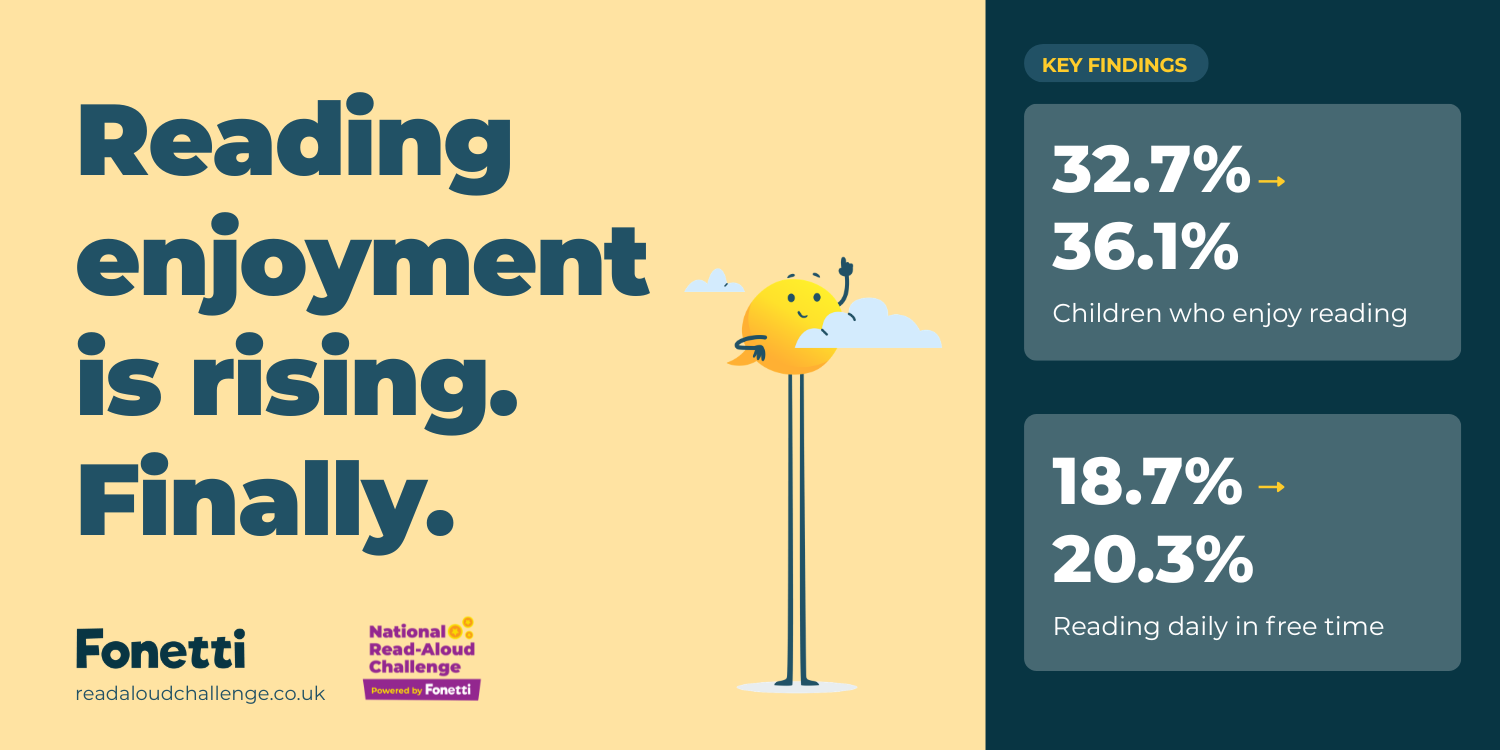
After four consecutive years of decline, reading enjoyment among children and young people aged 8 to 18 has increased from 32.7% in 2025 to 36.1% in 2026. At the same time, the proportion reading daily in their free time has risen from 18.7% to 20.3%, the first increase since 2023.
These are modest improvements, but important ones. After years of falling engagement, the data suggests the trend may finally be beginning to reverse.
Two trends moving in the same direction
The most striking finding from this year’s report isn’t simply that reading enjoyment has increased, or that daily reading has increased. It’s that both have increased together.
Reading enjoyment has long been recognised as one of the strongest predictors of whether children choose to read in their free time. The latest data reinforces that relationship.
The National Literacy Trust found that almost half (49.8%) of children who enjoy reading read every day in their free time. Among children who do not enjoy reading, that figure falls to just 4.5%.
Likewise, more than nine in ten (92.6%) children who enjoy reading read at least once a week, compared with just over a third (34.6%) of those who don’t.
In other words, children who enjoy reading are dramatically more likely to become regular readers.
The fact that both reading enjoyment and daily reading have risen together in 2026 is therefore unlikely to be a coincidence. It reflects the close relationship between children’s motivation to read and the reading behaviour that follows.
A recovery, but not yet a solution
While the direction of travel is encouraging, the wider picture shows why reading engagement remains such an important challenge.
Even after this year’s improvement, only 36.1% of children and young people say they enjoy reading, while only 20.3% read daily in their free time.
Both figures remain well below where they stood a decade ago.
The recovery is also uneven.
Older secondary pupils saw the largest improvements in both reading enjoyment and daily reading, particularly those aged 14 to 16 and 16 to 18.
By contrast, children aged 5 to 8 experienced a slight decline in reading enjoyment, driven by falling enjoyment among boys. Meanwhile, improvements among children eligible for free school meals were considerably smaller than among their peers, widening existing inequalities in both reading enjoyment and daily reading.
These findings are encouraging, but they also show that sustaining this recovery will require continued focus on the children who remain least engaged with reading.
Why this matters
At Fonetti, these findings closely reflect the argument we explored in our recent white paper on reading engagement.
Over the past decade, schools have made significant progress in teaching children to decode through systematic phonics. But learning to decode is only the beginning of reading development.
Long-term reading success depends on the accumulation of reading miles, the regular reading practice that builds vocabulary, language comprehension and reading fluency over time.
Children only accumulate those reading miles if they continue choosing to read.
That is why reading engagement matters.
Our recent white paper argues that reading engagement is the missing link between learning to read and continuing to read. Once children can decode, their continued reading development depends on whether they keep choosing to read. Reading enjoyment and reading confidence help shape that behaviour, encouraging children to return to books regularly and accumulate the reading miles that underpin vocabulary growth, language comprehension and long-term reading success.
The latest National Literacy Trust data reinforces that position. Children who enjoy reading are far more likely to read regularly, and as reading enjoyment begins to recover, daily reading appears to be recovering alongside it. The challenge now is ensuring that these improvements are not simply a short-term rebound, but the beginning of a sustained shift towards more frequent reading.
Looking ahead
The 2026 National Literacy Trust report provides genuine reasons for optimism.
For the first time in several years, both reading enjoyment and daily reading are moving in the right direction. That is good news for schools, educators and families alike.
The challenge now is to build on that momentum.
If more children are to become confident, capable readers, we must continue creating the conditions that encourage them to return to books day after day. Because while decoding opens the door to reading, it is sustained reading engagement, and the reading miles that follow, that ultimately determine how far children go.