England has emerged as one of the world’s strongest-performing countries for reading in PISA 2025. But look beyond the international comparisons and a more complicated picture emerges. England’s reading performance has barely changed in almost two decades. For a study of 15-year-olds, that raises an important question about what happens in all the years after children first learn to read.
The latest PISA results appear, at first glance, to be very good news for reading in England.
PISA, the Programme for International Student Assessment, is an international study run by the OECD that assesses the knowledge and skills of 15-year-olds around the world. Its assessments cover reading, mathematics and science, providing a way to compare the performance of education systems internationally and track how that performance changes over time.
That makes PISA particularly interesting when we think about reading. At 15, pupils are many years beyond the point at which they first learned to decode. The assessment gives us a picture of what their reading has developed into by adolescence.
And in PISA 2025, England performed strongly.
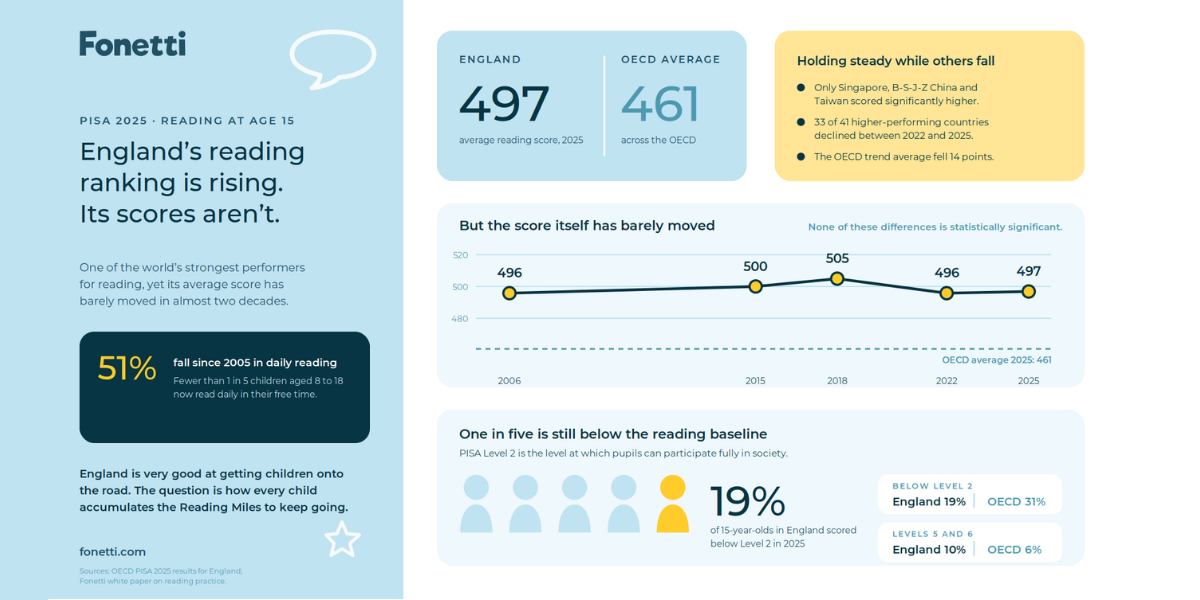
England achieved an average reading score of 497, significantly above the OECD average of 461. Only Singapore, B-S-J-Z China and Taiwan achieved scores that were significantly higher.
That deserves recognition, particularly because it comes against a difficult international backdrop. Among the 41 higher-performing countries included in PISA’s trend analysis, 33 experienced a significant decline in reading between 2022 and 2025. Across the OECD trend average, reading performance fell by 14 points.
England, by contrast, held steady.
But that distinction matters.
While England’s relative international position looks increasingly strong, our actual reading performance has barely changed.
England scored 496 in 2022, 505 in 2018 and 500 in 2015. None of those scores is statistically significantly different from the 497 recorded in 2025.
Go back further and the picture becomes even more striking.
England scored 496 in PISA reading in 2006.
Nearly two decades later, we are at 497.
So PISA 2025 tells two stories at once.
England has proved remarkably resilient at a time when reading performance has fallen substantially elsewhere. But we have yet to turn that resilience into meaningful improvement.
At 15, reading is about much more than being able to read
There is something particularly important about the age of the pupils PISA assesses.
PISA tests 15-year-olds.
These are not children at the beginning of their reading journey. For most, the mechanics of decoding should have been established many years earlier.
By 15, reading has become something much bigger.
PISA’s own definition reflects that. It defines reading literacy as the capacity to understand, use, evaluate, reflect on and engage with texts in order to achieve goals, develop knowledge and potential, and participate in society.
Its reading framework encompasses locating information, understanding, evaluating and reflecting, and reading fluency.
That distinction is important.
Learning to decode gives a child access to written language. But it is what happens in the years afterwards that helps them develop the vocabulary, knowledge, comprehension, fluency and stamina required to navigate increasingly complex texts.
Reading development does not stop when a child can successfully decode a page.
In many ways, that is when another stage begins.
What happens between 5 and 15?
Our recent white paper described the reading children accumulate over time as their “reading miles.”
It is a useful way to think about what happens during the years between learning to read and reaching the age assessed by PISA.
Every book, story, article and passage gives a child another encounter with written language. Over time, those encounters provide opportunities to meet unfamiliar vocabulary, develop fluency, build background knowledge and practise making meaning from increasingly complex texts.
No single book creates a proficient reader.
It is the accumulation that matters.
Once children have learned to decode accurately and confidently, reading itself becomes an essential part of how they continue to develop as readers. The more opportunities children have to engage meaningfully with texts, the more opportunities they have to practise and strengthen the skills that proficient reading demands.
And that makes the decline in children’s reading frequency particularly concerning.
As explored in our white paper, fewer than one in five children and young people aged 8 to 18 now report reading daily in their free time. The proportion reading daily has fallen by 51% since 2005.
PISA cannot tell us that this decline in reading frequency has caused England’s flat reading scores. The results do not establish that relationship, and we should not interpret them as doing so.
But when we are looking at reading outcomes at 15, reading practice has to be an important part of the conversation.
A 15-year-old has potentially had the best part of a decade to accumulate reading experience after learning to decode.
The question is: how many reading miles have they travelled along the way?
One in five 15-year-olds still does not reach the reading baseline
England’s strong national average can also obscure the pupils for whom reading remains a significant challenge.
PISA considers Level 2 its baseline level of reading proficiency. It represents the level at which pupils demonstrate sufficient reading skills to participate fully in society.
In England, 19% of pupils performed below that baseline in 2025.
England compares favourably internationally. Across the OECD, 31% of pupils were below Level 2. At the other end of the distribution, England also has a larger proportion of highly proficient readers, with 10% reaching Levels 5 or 6 compared with 6% across the OECD.
Those are important positives.
But 19% still represents almost one in every five 15-year-olds.
And again, the longer-term picture suggests limited movement. In 2022, 20% of pupils were below Level 2. In 2018 it was 17%, and in 2015 it was 18%. The PISA report notes that statistical significance for changes between these proficiency percentages could not be calculated at the time of publication.
So even within one of the world’s stronger-performing education systems, a substantial group of teenagers is reaching 15 without the reading proficiency PISA considers a baseline for full participation in society.
That should matter just as much as where England sits in an international table.
Reading is not a skill we complete
England has rightly placed enormous emphasis on early literacy.
Phonics matters. Decoding matters. Giving children strong foundations matters.
But perhaps PISA 2025 should encourage us to pay just as much attention to what comes next.
Reading is not a skill that children complete once they have learned its mechanics.
A five-year-old beginning to decode and a 15-year-old interpreting an unfamiliar, complex text are at very different points on the same developmental journey.
Between those two points sit thousands of encounters with written language.
Books read. New words encountered. Difficult passages worked through. Stories finished. Subjects explored. Ideas considered. Sentences read until processing them becomes increasingly automatic.
Those are the reading miles.
And the amount and quality of reading children experience during those years deserves to be a central part of our literacy conversation.
Our white paper identified what we called the decoding-attainment paradox. England has become highly effective at teaching the foundations of reading, yet that early success does not translate into equivalent attainment later in childhood. It argued that continued development after decoding depends increasingly on language comprehension, supported by accumulated reading experience.
PISA 2025 does not prove why England’s scores have remained broadly flat.
But it gives us another reason to ask what happens in the years after decoding has been mastered.
The next literacy challenge
PISA does not test children at the point when they are learning to read.
It tests them at 15, after years in which reading should have developed from something they are learning how to do into something they can use to learn, think, understand and participate in the world around them.
That makes the latest results both encouraging and challenging.
England is performing strongly compared with other countries. It has held its ground while many education systems have gone backwards.
But our absolute performance has barely moved.
If we want the next decade of PISA results to tell a different story, our national conversation about literacy cannot end when children learn to decode.
We need to think just as seriously about the years that follow. Are children reading frequently enough? Are they reading widely enough? Are they getting enough opportunities to encounter increasingly rich and challenging texts? And are we helping them develop the confidence and enjoyment that will keep them reading as they grow older?
Because the years between learning to read and reaching 15 are not simply time passing.
They are years in which reading experience accumulates.
England has become very good at getting children onto the road.
The question PISA 2025 should leave us asking is how we help every child accumulate the reading miles they need to keep moving forward.