For parents and educators, the promise of artificial intelligence in education is both exciting and daunting. We’re told that AI can tailor reading programmes, identify strengths and weaknesses, and recommend bespoke pathways faster than ever before. But as personalised learning technologies become more sophisticated, an essential question arises: How do we ensure personalisation doesn’t come at the expense of the human connection fundamental to learning?
Understanding Personalisation: The New Edge in EdTech Personalisation means more than auto-generated reading lists or smart assessments. In today’s EdTech landscape, AI is helping children learn at their own pace, spotlighting those who need extra support and celebrating unique learning journeys. Tools powered by machine learning, like the technology underpinning Fonetti’s Read Aloud Challenge, adapt to each child’s progress offering encouragement when needed and new challenges when ready.
While algorithms can identify patterns far more quickly than humans, they lack the empathy and intuition that only caring adults can provide. Without this human element, there is a real risk that education becomes a transactional process, reducing students to mere data points instead of nurturing them as individuals.
The Irreplaceable Role of Human Connection Research continually shows the value of teachers and parents who listen, understand, and advocate. When a child struggles with reading, it goes beyond correcting mistakes; The actual goal is to build confidence, resilience, and joy. AI can highlight which words are stumbling blocks, but it’s the adult’s patience and praise that make the breakthrough moments truly memorable.
In fact, many literacy experts believe the best results come from “AI-plus-human” partnerships. AI can suggest new books, flag disengagement, and recommend intervention, but only people can read the room, pick up on subtle emotional cues, and nurture lifelong curiosity.
Designing for Both: Lessons from EdTech Innovation Personalisation must always serve a human-centric learning experience. When developing speech recognition technology for reading aloud, the Fonetti team prioritises transparency and trust, where parents can track progress, and children always see their achievements celebrated by real people. Our technology never replaces the adult or teacher, but enhances and augments their feedback.
Thoughtful design ensures that every child’s reading journey feels personal, not impersonal. That means AI recommendations support, rather than dictate, choices, and young learners feel seen, heard, and understood.
Questions for the Future: Where Do We Draw the Line? As AI continues to evolve, the education community faces big questions. How far should automation go before it risks alienating the very learners it aims to help? What checks and balances ensure that EdTech remains accountable and inclusive? Further how do we support parents and teachers to harness AI’s power without sacrificing the warmth and wisdom that only humans bring?
At every step, the principle remains clear: personalisation must lead to connection, not isolation.
Conclusion: Empowered Learners, Human Teachers EdTech is reshaping classrooms and living rooms across the country. The challenge isn’t whether to use AI, but how to use it wisely. By keeping human connection at the heart of personalisation, we can help every learner reach their potential and ensure that technology supports, but never replaces, the magic of learning together.
When we think of reading aloud, we often see it as a stepping stone to helping children with vocabulary, fluency, and comprehension. Increasingly, research shows that its impact reaches much further. Reading aloud not only builds readers, it also promotes brain development. From memory to social understanding, and from confidence to connection, this simple habit brings lifelong benefits.
How Reading Aloud Shapes the Brain
Boosts Memory – Speaking words out loud improves recall, a phenomenon known as the production effect. By seeing, saying, and hearing words, children create stronger memory traces than through silent reading alone.
Strengthens Neural Connections – Reading aloud engages multiple systems at once: vision, speech, hearing, and language comprehension. This multi sensory workout reinforces the links between brain regions, building foundations for focus, problem-solving, and flexible thinking.
Supports Comprehension for Struggling Readers – For children who find decoding difficult, hearing text read aloud provides a framework for understanding. Assistive technologies, now used in many UK classrooms, show that combining audio with visual text can raise comprehension and confidence.
Benefits Beyond Literacy Reading aloud helps children develop skills that extend well beyond the classroom:
Attention and focus: Following along encourages concentration.
Imagination: Stories stimulate mental imagery and creative thinking.
Empathy and perspective: Hearing stories deepens emotional understanding.
Confidence and independence: Shared reading empowers children to engage with texts they might find challenging alone.
Stronger relationships: Reading together nurtures bonds between children, parents, and teachers.
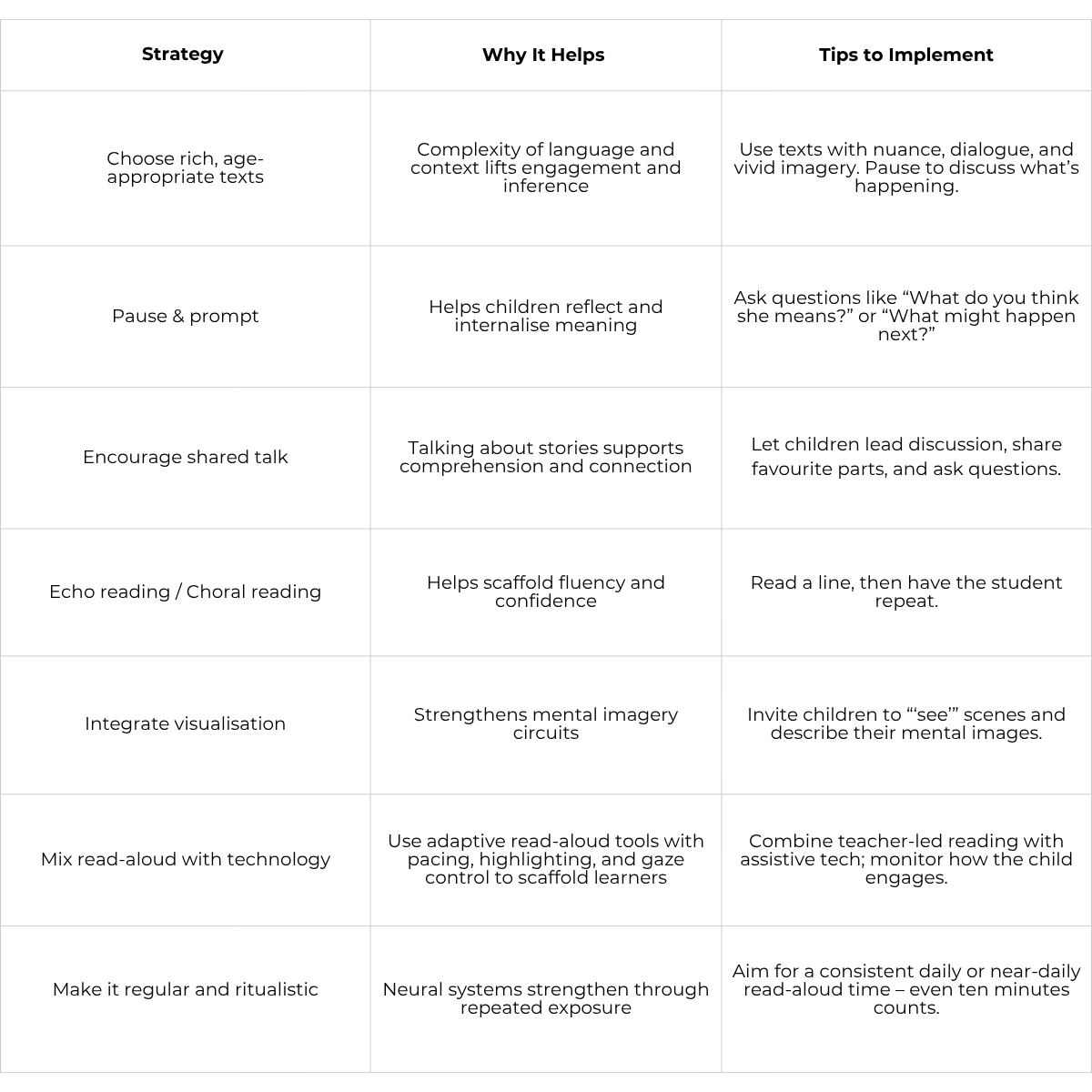
Practical Strategies for Parents and Teachers To maximise the brain-building benefits of reading aloud, here are strategies you can adopt:
The Role of Technology, and the Rise of ASR As educational practice evolves, digital tools now play a significant part in making read-aloud more accessible and engaging. A key advancement is Automatic Speech Recognition (“ASR”) technology. ASR offers direct, real-time feedback as children read aloud, helping them refine fluency and accuracy independently. This proves invaluable for those children who may not have adult support at home, allowing them to build confidence through solo practice.
For teachers, ASR applications provide data and analysis regarding each child’s reading performance, helping guide in-class learning and allowing for targeted intervention. Many solutions also incorporate gamification badges, progress scores, and reading challenges – which serve to increase engagement and motivation in young readers.
Looking Ahead: Read-Aloud in a Changing World For parents, reading aloud is a daily ritual that goes beyond story time. Only ten minutes of shared reading can boost a child’s confidence, imagination, and sense of connection. For teachers, it is a proven strategy to support comprehension, especially when layered with evidence-based practices and adaptive technologies now widely available in UK classrooms.
Digital platforms utilising ASR, now put these scientific principles into practice. Fonetti, for example, uses ASR to provide children with instant feedback on their reading, while engaging them through gamified rewards and progress tracking. This fusion of science and technology helps struggling readers build independence, without diminishing the human connection found in shared reading experiences.
The opportunity for both parents and educators lies in treating reading aloud not as an optional extra, but as a cornerstone of development. It is a practice that supports brain growth, literacy, and, ultimately, the life skills young people need to thrive in the ever-changing future.
Once upon a time, in a small mining village in South Yorkshire, there was a boy who hated reading. For young David Lawrence Jones, stories felt like chores, words like barriers. He was certain he’d never be a reader.
And yet, everything changed in the most unexpected way.
That boy who once dreaded opening a book grew up to become one of the UK’s most beloved children’s authors, a tireless champion of literacy, and the creative mind behind bestselling adventures and even a hit animated educational series. Today, David Lawrence Jones inspires thousands of children every year – proving that sometimes, all it takes is a single spark to set a lifelong love of reading ablaze.
But how did a reluctant reader become the author who now dedicates his life to helping children discover the magic of books? The story begins with one simple gift from his teacher – a gift that would change his life forever…
David Lawrence Jones’ Early Reading Journey
How a Teacher’s Gift Turned David into a Reader David was born in 1964 in the mining village of Ravenfield, near Rotherham in South Yorkshire. Like many children, he was a reluctant reader – he simply didn’t want to pick up a book. No matter how hard his mother tried, nothing could spark his interest. Reading felt like a chore to be avoided at all costs. But everything changed in 1971, when David was just seven years old. It all began with a simple yet extraordinary idea from his school teacher – an idea that would transform David’s world. Instead of pushing him to read, the teacher decided to give him a present.
And children love presents. David was no exception.
One day, his mother arrived home with a carefully wrapped package bearing his name. Excitement bubbled inside him as he tried to guess what might be inside. A toy? A game? His imagination raced.
But when he tore off the paper, he found… a book.
Disappointment hit. A book? Really? The last thing David wanted was more reading. Yet there it was: a story from Enid Blyton’s Secret Seven series – seven child detectives with a keen eye for mystery and adventure. Ironically, it was David’s own curiosity – just like the Secret Seven’s – that began to stir. What was inside those pages? Could it really be that bad to read just a few?
He gave in. And from the moment he began following Peter, Janet, Pam, Barbara, Jack, Colin and George through their thrilling investigations, he was hooked. He didn’t just finish the book – he devoured it. That one gift had cracked the case: David was now a reader. From that moment on, his relationship with books was transformed forever.
From Bedtime Tales to Bestsellers Although it took time for David to fall in love with reading, his imagination had always been alive. Sharing a bedroom with his older brother, he would invent bedtime stories – not out of any grand plan, but simply to keep his brother quiet at night! Yet those whispered tales planted the seeds of something much bigger.
Years later, parenthood opened the door to an extraordinary twist of fate. In 2009, while browsing the shelves of his local Waterstones in Torquay with his young daughter, David stumbled across a Community Activity Scheme inviting local unpublished authors to submit their work. He seized the moment. Soon after, his first book – Bradley Baker and the Curse of Pathylon – was published. Readers were captivated by Bradley’s daring quest to save the king and break an ancient curse. The book didn’t just sell – it flew off the shelves. Within weeks, David had achieved the second-highest sales in his store’s location.
What began as a chance encounter quickly grew into a full-fledged career. David toured Waterstones stores, hosting lively “meet-the-author” events and securing further publishing deals. Since then, he has written four more books in the bestselling Bradley Baker Adventure series, cementing Bradley as a firm favourite among young readers.
But David didn’t stop there. His imagination created Jig and Saw – a tale of a brother and sister who discover a magical cupboard leading to a land of board games – and Devon Farm Adventures, a rhyming picture book series introducing children to the joys of countryside life. Both, now available on Fonetti, continue David’s mission to spark the same wonder that first lit up his imagination as a child.
David Lawrence Jones Inspiring Young Readers
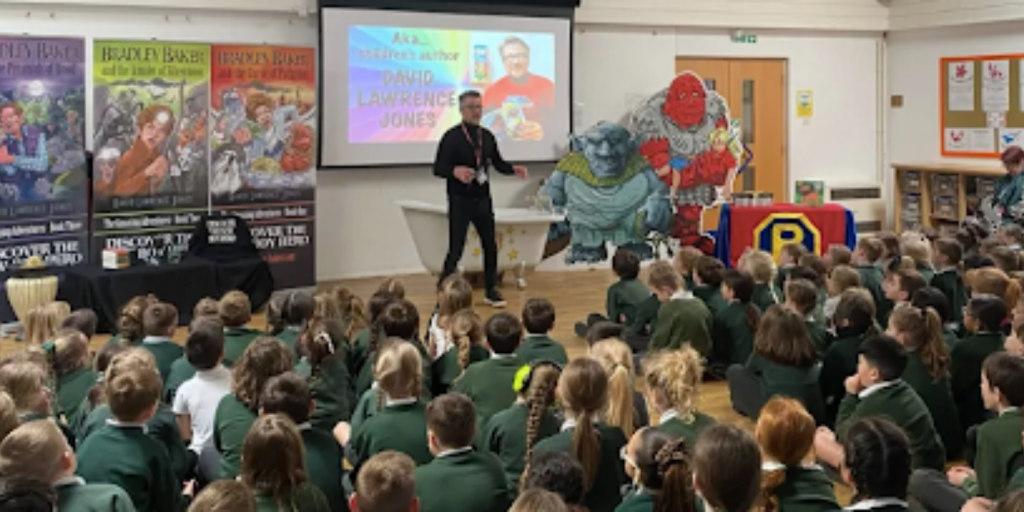
A Mission to Inspire a Love of Reading: Interactive Showcase Presentations Since becoming a published author, David has dedicated his life not only to writing captivating stories but also to sharing the joy of reading with children across the UK. His high-energy school tours are legendary – packed with theatrical flair, colourful props (including his famous glowing bathtub!), and endless opportunities for children to join in the adventure.
In 2025, he returns to schools nationwide with renewed passion and a new two-day format: a whole-school showcase followed by a book signing where children can meet him, ask questions, and take home signed copies. Demand is higher than ever, with over a hundred schools booking him each year – most through glowing recommendations. As David often jokes, “How long will I keep presenting at schools?… Until I collapse in an exhausted heap – as long as my books continue to inspire children to read.”
Literacy Workshops Beyond the stage, David leads smaller, hands-on workshops where pupils create their own characters, storylines, and comic strips. They experience the full writing process – planning, drafting, editing, and proofreading – boosting their confidence as young authors. Many schools combine a showcase with a workshop, ensuring even the most reluctant readers leave inspired.
Super Geek Heroes & Super Geek Island Never one to stop at the page, David also created The Super Geek Heroes, a 3D animated series blending fun, adventure, and education for early years learners. The seven super-kids – Ant Active, Ronnie Rock, Millie Maths, Jake Jotter, Suzi Smiles, Peter Planet, and Vicky Voice – each represent a key Early Years Foundation Stage (EYFS) goal, turning learning into superhero missions. Building on this success, David co-founded Super Geek Island, an interactive online platform for EYFS learners to dive deeper into the world of learning.
Chancellor of the Devon & Cornwall Children’s University Since 2012, David has proudly served as Chancellor of the Devon & Cornwall Children’s University, helping give children aged 5 to 14 access to enriching learning opportunities outside school. To support the cause, he even wrote Cub’s Adventures, following the University’s mascot across the South West to a graduation ceremony at the University of Plymouth. Through this role, David champions social mobility, ensuring every child – whatever their background – has the chance to dream big.
From packed school halls to intimate workshops, from bestselling books to animated adventures, David’s mission has remained the same: helping children discover the joy of reading and the confidence to keep turning the page.
Celebrating Young Readers and Literacy Achievement
A Shared Mission – How David’s Passion for Literacy Resonates with Fonetti David’s journey – from reluctant reader to bestselling author – resonates deeply with Fonetti’s vision. Having once struggled himself, he understands the challenge of sparking a child’s interest in reading better than most. That early struggle makes his mission – and his success in helping others – all the more powerful.
At Fonetti, we share that mission: to ensure every child discovers the joy of reading. Like David, we believe it’s not just about stories, but about confidence, opportunity, and giving children the tools to succeed. Just as David uses creativity and fun to inspire young readers, Fonetti harnesses cutting-edge technology, using ASR and AI to provide real-time feedback that keeps children engaged and progressing.
It’s why we’re so proud to host David’s Jig and Saw and Devon Farm Adventures series on Fonetti, so even more children can enjoy them and discover the magic of reading for themselves. You can explore David’s books right now on Fonetti. For those who’d like to purchase his books directly or book David for an unforgettable school visit, we’ve included a link to his official website below, along with links to The Super Geek Heroes animation series and Super Geek Island learning platform.
David Lawrence Jones proves that no child is ever truly a reluctant reader – they just haven’t found the right story yet. At Fonetti, we’re proud to share his stories and continue his mission: ensuring every child has the chance to discover the magic of reading.
Imagine if, instead of just turning pages, a book could listen. What if it could gently prompt a child when they misread a word, cheer them on when they pronounce something correctly, and track their progress over time – all without needing an adult to hover nearby?
This is no longer the stuff of imagination. Thanks to Automatic Speech Recognition (ASR), books are beginning to talk back. And for young readers, that changes everything.
📖 The Traditional Reading Model – and Its Limits For generations, reading has been a largely one-way experience. A child sits with a book and decodes the words on the page. When possible, a parent, teacher or older sibling might listen, correct mispronunciations, and encourage fluency. But in busy homes and overstretched classrooms, this kind of attentive one-to-one support isn’t always available. That’s where children can fall behind – not for lack of will, but for lack of real-time, personalised feedback.
💡 Enter ASR: A Reading Revolution Automatic Speech Recognition bridges this gap. When embedded in EdTech tools like Fonetti, ASR listens as a child reads aloud, assessing accuracy and fluency in real time. If a child stumbles, skips a word, or mispronounces something, the technology gently flags it. If they improve, it celebrates them. This creates an interactive loop: the child reads, the technology listens and responds, and the child adjusts – learning as they go. It’s the kind of responsive support that builds not just literacy, but confidence.
🔄 Practice, Feedback, Progress The secret sauce in learning to read fluently is repetition with feedback. ASR tools encourage children to read aloud more often – something that traditional reading apps or eBooks rarely promote. And because the feedback is immediate, children begin to self-correct. They develop an ear for their own accuracy. Over time, this builds fluency, comprehension, and a deeper sense of achievement. It’s no longer about “getting through the page” – it’s about reading well, and knowing you’re reading well.
🧑🏫 Supporting Teachers with Actionable Insights One of the often-overlooked benefits of ASR technology is the visibility it provides to teachers. With platforms like Fonetti, teachers gain access to a dedicated portal that tracks each pupil’s reading activity – including accuracy, fluency, and consistency over time. This data helps teachers quickly identify which pupils are thriving and which ones may need targeted support – whether it’s help with decoding, pronunciation, or reading stamina. In short, ASR doesn’t just support the child – it supports the whole classroom ecosystem.
By freeing up time and providing clear insights, ASR allows teachers to do what they do best: personalise learning and support every child, no matter their starting point.
🌍 Accessible, Scalable, Empowering Perhaps one of the most powerful aspects of ASR is its scalability. Not every child has daily access to an adult who can sit and listen while they practise reading. ASR levels the playing field – bringing high-quality support into homes, classrooms, and communities where it might otherwise be lacking. It empowers teachers with data. It gives parents peace of mind. And most importantly, it gives children a sense of ownership over their reading journey.
🚀 The Future of Reading Is Interactive Reading doesn’t have to be passive. With the help of ASR, we’re moving toward a world where every child can hear how they’re doing, see their progress, and feel proud of how far they’ve come. At Fonetti, we believe books should be engaging, encouraging – and just a little bit magical. And when books talk back, that magic becomes real.
📢 Try It for Yourself: Join the National Read Aloud Challenge! If you’re curious about how ASR can support your child’s reading, there’s no better time to give it a go. The National Read Aloud Challenge is still open – and it’s the perfect opportunity for children to experience Fonetti’s interactive, voice-powered reading platform for themselves.
Whether your child is a confident reader or just starting out, the challenge is designed to encourage regular reading aloud and make it fun. With built-in feedback, progress tracking, and a growing library of engaging stories, Fonetti helps every child become a stronger, more fluent reader.
Last week, the Department for Education, in conjunction with the National Literacy Trust, announced that 2026 will be the National Year of Reading – and as a company that has spent a decade working to improve children’s reading, we couldn’t be more delighted.
In a speech made by Education Secretary Bridget Phillipson, the campaign pledged to shine a spotlight on reading, with a particular focus on reading for pleasure. The initiative aims to reignite children’s love of books, recognising that fostering enjoyment is one of the most effective ways to improve literacy levels – and transform lives.
The Reading for Pleasure Challenge The decision comes at a crucial time. Data from the National Literacy Trust shows a worrying decline in reading for pleasure among children and young people aged 8-18. In fact, their 2025 survey revealed that just 32.7% of children said they enjoyed reading in their free time – the lowest figure recorded since the Trust began collecting this data in 2005. This trend has been steadily worsening, and the consequences are significant.
Why Reading for Pleasure Matters Reading for pleasure isn’t just about fun – although fun is a crucial part of it. It’s about building confidence, curiosity, and fluency. Numerous studies have shown that children who enjoy reading are more likely to perform well across the curriculum, develop stronger vocabulary, and have better mental wellbeing. It’s one of the single biggest predictors of future academic success – even more so than a parent’s level of education or socio-economic background.
Why Fonetti Supports the National Year of Reading At Fonetti, we’ve long believed that every year should be the year of reading. But we wholeheartedly support the government’s renewed focus, especially its emphasis on reading for pleasure. We’ve always said that helping children love reading is the key to improving their reading skills – and we believe technology has a powerful role to play in making that happen. Fonetti was built on this belief. Our interactive, speech recognition-powered reading app helps children read aloud with confidence and independence, while making the experience engaging, gamified, and fun. As children grow up surrounded by screens, we believe in using that to our advantage. By bringing together the best of edtech and education, we can help turn screen time into story time – and stories into stepping stones for lifelong learning.
Our recent white paper, commissioned by Auris Tech, explores exactly this: how Automatic Speech Recognition (ASR) technology can support children’s reading development and promote reading for pleasure. The research makes clear that ASR offers a scalable, interactive and child-friendly solution to some of the biggest challenges in literacy education today. If you haven’t read our whitepaper yet it can be accessed here: Reading Aloud Using Automatic Speech Recognition (ASR) To Improve Children’s Reading — Auris Tech
Looking Ahead We’re proud to stand with the Department for Education, the National Literacy Trust and all the organisations rallying behind this campaign. The National Year of Reading 2026 is a welcome opportunity to refocus attention, energy and innovation on one of the most important issues of our time: ensuring every child has the tools, confidence, and love of reading they need to thrive.
Part 2 of a two-part series on the Simple View of Reading.
When we think about helping children learn to read, it’s easy to focus only on outcomes – how many books they finish, how well they can read aloud in front of others, or how soon they become “independent” readers. But before we can talk about progress, it’s important to understand what reading actually involves.
That’s where the Simple View of Reading comes in.
Originally proposed by researchers Philip Gough and William Tunmer in 1986, the Simple View of Reading is the model that underpins the National Curriculum in England today. It breaks reading down into two core components:
Decoding (or word reading) – the ability to identify and pronounce words using knowledge of letters and sounds.
Language comprehension – the ability to understand what those words and sentences actually mean, in context.
Children need to be proficient in both of these areas to become confident, capable readers. Without decoding, they can’t read the words; without comprehension, the words have no meaning. You can think of it as a simple equation:
Reading = Decoding × Comprehension
If either skill is missing (or weak), reading breaks down.
In this two-part blog series, we’ll explore both elements of the Simple View of Reading and how reading aloud can support children’s development in each. In last week’s blog we discussed decoding – also known as word reading. This week we turn our attention to Language Comprehension.
Understanding language comprehension To put it simply, Language comprehension is the ability to understand the words, sentences and the wider context of what we are reading or hearing. It is essentially to derive meaning from what we are reading or hearing.
How Reading Aloud Supports Language Comprehension: Bridging the vocabulary gap Before children begin learning to read for themselves, their understanding of language is largely developed through speaking and listening. These early interactions help them build vocabulary, understand how words fit together, and begin to recognise the patterns of language.
But not all children have the same early experiences. For those growing up in language-poor environments – where adult conversation is limited in quality or quantity – their exposure to new vocabulary can be significantly reduced. This difference is commonly referred to as the word gap, and studies have estimated that by the time children start school, this gap can amount to tens of millions of words [5].
The gap isn’t just about spoken language – it also shows up in reading habits. A study by researchers at Ohio State University found that children in households where books were read aloud regularly had heard around 1.4 million more words by the age of five than those whose parents read to them only occasionally [35].
This early deficit in vocabulary and language exposure can have long-term effects. Recognising this, the 2021 reforms to the Early Years Foundation Stage highlighted the need to support children from language-poor homes by increasing their access to high-quality spoken language experiences [36].
Reading aloud is a powerful way to do just that. Unlike silent reading, it models pronunciation, rhythm, and sentence structure, while also encouraging active engagement and listening. Most importantly, it supports the development of speaking skills, helping children use and internalise vocabulary they may not have encountered at home.
Reading aloud vs reading silently – the impact on retention and recall Language comprehension isn’t just about understanding a word once – it’s about being able to retain and recall it when needed. These are essential building blocks for more advanced reading comprehension.
Research shows that when children read aloud, they are significantly more likely to remember what they’ve read than when they read silently [37 – 40]. One study involving children aged 7 – 10 found that participants correctly recognised 87% of words they read aloud, compared to just 70% of those read silently [40].
This difference is explained by what psychologists call the “production effect” [37]. Reading aloud involves two distinct and reinforcing processes:
An active motor act – speaking the word
A self-referential auditory input – hearing themselves say it
Together, these processes make new words more memorable. In fact, even whispering, mouthing, or writing the words out can help improve recall compared to reading silently, because these methods all engage additional sensory or motor pathways [39].
So if the goal is to build comprehension through vocabulary retention, reading aloud wins hands down.
Oral language and comprehension go hand-in-hand The benefits of reading aloud go beyond memory. The Education Endowment Foundation (EEF), in their guidance on improving literacy in Key Stage 1, highlight the importance of explicitly developing children’s speaking skills as part of improving reading comprehension [41].
Reading stories aloud – whether by an adult or the child themselves – provides valuable opportunities for conversation. Children can ask questions, make predictions, and reflect on what they’ve read, all of which help deepen their understanding of the text. This is supported by research into interventions for children with reading difficulties. One study found that children who participated in oral language training made the greatest gains in reading comprehension, compared to those using other types of intervention [42].
Reading aloud encourages children to process language more deeply, make connections between spoken and written language, and practise using new vocabulary in context – all essential components of strong comprehension.
Final Thoughts When we think about reading aloud, we often picture young children cuddled up with picture books. But its benefits extend far beyond the early years. Whether it’s a five-year-old learning the rhythm of language or a ten-year-old building vocabulary through complex narratives, reading aloud remains one of the most powerful tools we have to support language comprehension. And since comprehension is one half of the Simple View of Reading equation, that makes reading aloud essential – not optional – for every child learning to read.
So let’s keep the stories flowing. Let’s read aloud, every day, to give every child the language foundation they deserve.
Part 1 of a two-part series on the Simple View of Reading
When we think about helping children learn to read, it’s easy to focus only on outcomes – how many books they finish, how well they can read aloud in front of others, or how soon they become “independent” readers. But before we can talk about progress, it’s important to understand what reading actually involves.
That’s where the Simple View of Reading comes in.
Originally proposed by researchers Philip Gough and William Tunmer in 1986, the Simple View of Reading is the model that underpins the National Curriculum in England today. It breaks reading down into two core components:
Decoding (or word reading) – the ability to identify and pronounce words using knowledge of letters and sounds.
Language comprehension – the ability to understand what those words and sentences actually mean, in context.
Children need to be proficient in both of these areas to become confident, capable readers. Without decoding, they can’t read the words; without comprehension, the words have no meaning. You can think of it as a simple equation:
Reading = Decoding × Comprehension
If either skill is missing (or weak), reading breaks down.
In this two-part blog series, we’ll explore both elements of the Simple View of Reading and how reading aloud can support children’s development in each. Today, we start with decoding – also known as word reading.
Understanding Decoding (Word Reading) Before jumping into the benefits of reading aloud, let’s take a moment to understand what decoding actually means. In simple terms, decoding refers to a child’s ability to read unfamiliar words by sounding out letters and blending those sounds together – either silently or aloud. To do this successfully, children must be explicitly taught how letters (or ‘graphemes’) correspond to particular sounds (‘phonemes’).
With enough practice, children begin to recognise and decode familiar words automatically, without needing to sound them out each time. But getting to that point takes both structured phonics instruction and regular practice.
How Reading Aloud Supports Decoding Skills: The Synthetic Phonics Programme When children first learn to read in Key Stage 1, they are taught how to decode words through a synthetic phonics programme. (‘Synthetic’ in this context means to combine – synthesising letter sounds into words.) This involves learning the phonemes that match each grapheme and how these can be blended to form words.
Phonics instruction has been hugely successful: 89% of pupils met the expected standard in the Phonics Screening Check by the end of KS1 in 2023. However, while reading aloud can’t replace phonics teaching, it can play a significant supporting role. Reading aloud:
Exposes children to phonics in varied contexts.
Reinforces sound-letter recall through repetition.
Encourages children to produce sounds themselves – not just hear them.
This active vocalisation helps strengthen the brain’s connection between letters and sounds, which is vital when children come across new or unfamiliar words. Importantly, this benefit extends to children with learning difficulties like dyslexia. Studies show that reading aloud – through articulation and prosody – makes reading a multi-sensory task. Hearing themselves read allows dyslexic students to self-correct in a way that doesn’t typically happen during silent reading.
So, when reading aloud is combined with a phonics programme – and the chosen texts match the child’s current phonic knowledge – it can significantly boost progress, especially ahead of the Phonics Screening Check in Year 1 or 2.
From Decoding to Fluency Once decoding becomes more automatic, children begin to develop reading fluency – often described as the bridge between decoding and comprehension. A fluent reader can read accurately, at an appropriate pace, and with expression (prosody). Reading aloud is one of the most effective ways to build fluency. It helps children:
Hear and adjust their reading speed to avoid stumbling or skipping.
Engage with punctuation (e.g., pausing at full stops).
Practise using stress and intonation, making reading more expressive and engaging.
According to the Standards and Testing Agency, around 90 words per minute is a key fluency benchmark by the end of KS1 – and reading aloud can help children reach that goal.
As children become more fluent, they also tend to enjoy reading more – and children who enjoy reading are more likely to read frequently. It’s a virtuous cycle.
Beyond Reading: Oracy and Confidence Reading aloud doesn’t just support decoding and fluency – it also develops oracy skills, defined as “the development and application of a set of skills associated with effective spoken communication.” These skills are not only vital for success in school, but they are increasingly valued in the workplace too.
Reading aloud gives children the chance to practise spoken communication alongside their reading skills – a benefit that silent reading simply doesn’t offer. For teachers, it’s also a practical way to encourage oracy practice outside the classroom, particularly for children from language-poor households or with lower language skills. Teachers have consistently identified pupils with English as an additional language (73%), disadvantaged pupils (71%), and pupils with low attainment (68%) as the groups who would benefit most from increased speaking activities. Reading aloud offers a simple but effective intervention.
And finally, there’s confidence. For many children, speaking or reading in front of others can be daunting – especially if they struggle with reading. A drop in reading confidence has been noted in recent years, falling to just 45% in 2021. Reading aloud in a safe, private space – whether at home or in a supportive classroom setting – gives children a chance to build confidence in their own time. Over time, this can reduce anxiety, boost self-esteem, and prepare them to participate more actively in school oracy-based activities.
In Summary While a strong phonics programme lays the foundation for decoding, reading aloud brings that learning to life – helping to embed phonics knowledge, build fluency, strengthen oracy, and boost confidence. It turns reading into a multi-sensory, engaging, and empowering experience.
In next week’s blog, we’ll explore how reading aloud can also support the other half of the Simple View of Reading: language comprehension. Stay tuned.
At just seven years old, I was diagnosed with dyslexia. Reading was always a struggle for me, and because it took so much time and effort, I became a reluctant reader. I found little enjoyment in it – every page felt like a mountain to climb. Whenever I returned to a book the next day, I had to reread the same page just to make it sink in. The first time I read any text, I was concentrating so hard on deciphering the words that I couldn’t retain what I had actually read.
I remember, around the age of thirteen, my parents gave me a book called Flowers in the Attic by Virginia Andrews. Many of my friends had already read it and raved about it, and I desperately wanted to be able to join their conversations. Determined, I decided to give it my best shot.
I opened the book and approached it ‘one page at a time’. But the familiar pattern happened again – I would read a page, then have to reread it over and over again to make it stick. Despite this, I became hooked. Gradually, I started reading a few pages at a time, though I still had to reread the last paragraph each time I picked the book up again. It took me nine months to finish it, but when I finally reached the last page, the sense of achievement was overwhelming. I was able to discuss the story with my friends and stepsisters who had finished it months before. Riding the wave of excitement, I picked up the next book in the series, Petals on the Wind, but the progress was so slow that I eventually gave up.
Fast forward to recently: I was visiting my grandparents in Hastings when my grandmother mentioned a series she had just finished watching on Channel 5. It was Flowers in the Attic – the origin story! Hearing this instantly transported me back to my early reading struggles and the pride I felt when I finished that first novel.
That evening, I went home and binge-watched the first three episodes, staying up into the early hours, completely gripped. The series gave so much more context to the characters, especially the grandmother, and I was fascinated to learn about her younger years. The following night, I watched the final episode, and the story reignited a strong desire to reread the book.
I knew I had a copy somewhere (ironically, I thought it might be in my attic!). Unable to find it, I jumped onto Amazon and discovered that while buying the individual book cost £9.99, the entire four-book series was only £16.99. Needless to say, I bought the set!
When the books arrived the next day, I couldn’t wait to get started. That evening, I curled up and began rereading a story so close to my heart – one that had once taken me months to finish. This time was different. I couldn’t put it down. It was a bank holiday weekend, and on Monday I lay on my bed from 8 a.m. until 11 p.m., reading non-stop. I ignored my phone, not wanting any interruptions.
In just two days, I devoured the entire book.
Without missing a beat, I picked up Petals on the Wind, and I’m now racing through it, reading at every opportunity – whether it’s a spare five minutes or a quiet evening. Within just four days, I’m nearing the end, and I’m already excited to start the third book later this week.
Through my work with Fonetti, I regularly read aloud using our app to test new books and demonstrate to schools across the country. This daily reading practice has dramatically improved my fluency, confidence, and enjoyment – to the point where I can now lose myself in novels in a way I once thought impossible.
That’s not to say the challenges of dyslexia have disappeared – they haven’t. Once a dyslexic, always a dyslexic. But with practice, you learn to overcome the hurdles. I now have the skills to decode difficult words. Sometimes I still wish I could double-tap a word like you can on Fonetti to hear it read aloud – that feature would be very handy with a physical book!
It may have taken me over 40 years to truly fall in love with reading, but I can now confidently say: I am an avid bookworm.
It was a claim repeated again and again during the 2024 general election campaign by the Conservative Party. In this blog, we’ll take a closer look at the data behind the claim and assess whether it really stacks up.
The Claim:“English children are the best readers in the western world”
The Answer: Technically Yes, But Really No
Let us explain…
This claim refers to results from the latest iteration of the Progress in International Reading Literacy Study (PIRLS) conducted in 2021. PIRLS is a standardised assessment that measures the reading ability of 10-year-olds across the globe. The 2021 study assessed nearly 400,000 pupils in 57 countries, despite widespread disruption caused by the Covid-19 pandemic. PIRLS focuses on three key aspects of reading literacy:
How pupils read different types of texts;
The reading comprehension strategies they use;
Their attitudes towards reading.
Technically Yes… In the 2021 PIRLS results, England ranked fourth out of 43 countries, with an average reading score of 558. This was behind only Singapore (587), Hong Kong (573), and Russia (567). This result means that England outperformed every other European or North American country. In this sense, English 10-year-olds were the highest scorers in the western world according to the 2021 PIRLS study.
So when former Prime Minister Rishi Sunak MP, current Leader of the Opposition Kemi Badenoch MP, and others in the Conservative Party say England has the best young readers in the western world, they are technically correct – at least according to this one study.
However, There’s a Big Asterisk England moved up from joint 8th place in the 2016 PIRLS study to 4th in 2021. While this might seem like a success story, the leap is likely explained by data collection anomalies linked to the pandemic. In fact, the Department for Education (DfE) itself urged caution when comparing England’s results with other countries in this edition. Here’s why…
England Delayed Its Testing by One Year Due to the pandemic, England postponed its PIRLS data collection by a full academic year – testing pupils in 2021 – 22 instead of 2020 – 21, as most other countries did. This meant England’s pupils avoided the worst disruption to schooling caused by Covid-19.
According to a 2021 Ofqual report, primary school teachers identified reading and phonics as the areas of learning most negatively impacted by pandemic-related disruptions. So, it’s fair to say that testing children a year later gave England a notable advantage.
While we can’t say exactly how England would have scored if tested on schedule – or how other nations might have performed if they’d waited too – it’s worth noting that 7 of the 9 countries who previously scored higher or equal to England in 2016 did test during the pandemic peak, likely contributing to their drop in scores. Reflected by the sharp 19 points drop in the international median score between 2016 and 2021.
Other Countries Were Disqualified from the Leaderboard Fourteen education systems – including the USA, Ireland, and Northern Ireland – chose to delay their PIRLS testing by around six months. As a result, they assessed slightly older students and were disqualified from the official leaderboard for not following the standard protocol.
This is significant. Both Ireland and Northern Ireland, which historically outperform England in PIRLS, scored 19 and 8 points higher than England in 2021 – but were disqualified from the official leaderboard due to testing an older cohort of pupils. Had they tested on schedule, they might still have ranked above England.
So while England’s “top of the West” title is technically valid, it’s due in large part to having avoided the worst of the pandemic’s educational fallout and because several stronger-performing countries were excluded from the rankings. In short, any claim that England’s 10-year-olds are the “best readers in the western world” should come with a large asterisk – and a dose of caution.
The Real Problem With the Claim Yes, politicians are technically entitled to make this claim based on the 2021 PIRLS results. But the real danger lies in how it’s received. If people believe England’s reading education is world-leading, they may conclude that no further action is needed to support children’s reading development.
This couldn’t be further from the truth…
A Look at Long-Term Trends
England’s PIRLS Scores Over Time:
Despite moving from 19th in 2006 to 4th in 2021, England’s average score (558) hasn’t changed much in two decades. It was 553 in 2001, 552 in 2011, and 559 in 2016. In other words, we’ve stayed fairly static in terms of actual progress.
England’s PISA Scores Over Time:
England also improved its position in the OECD’s Programme for International Student Assessment (PISA) for 15-year-olds – from 25th in 2009 to 12th in 2022. But the average reading score in 2022 (496) was lower than in 2012 (500), 2015 (500), and 2018 (505) and similar to 2006 (496) and 2009 (495).
Key Stage 2 Standards:
In 2023/24, 26% of Year 6 pupils – about 170,640 children – did not meet the expected reading standard. That means over a quarter of pupils are entering secondary school without the literacy skills they need.
Declining Reading Enjoyment and Frequency:
2024 saw the lowest levels of reading enjoyment and frequency since records began. Just 34.6% of children said they enjoyed reading – a drop of 8.8 percentage points from 2023. Only 20.5% read daily, down almost 50% compared to two decades ago.
And this matters: children who enjoy reading and do it frequently are significantly more likely to become skilled readers.
Conclusion: Why the Real Reading Challenge Still Lies Ahead So, are English readers really the best in the western world? On paper, maybe. But the 2021 PIRLS results don’t tell the full story, and they certainly shouldn’t lead us to complacency. Literacy progress in England has stagnated, and too many children are still leaving primary school without the reading skills they need.
At Fonetti, we believe that every child deserves not just to learn to read but to love reading. That’s why we’re working to make reading accessible, engaging, and empowering – especially for those who need it most. By using voice recognition to support and reward children as they read aloud, Fonetti helps build fluency, confidence, and a genuine love of books.
We don’t just want England to rank well on global leaderboards – we want every child in the UK to feel like the best reader in the world. And that’s a challenge worth tackling.
From deciphering classroom instructions to navigating the complexities of future careers, reading permeates every aspect of our lives. For children, mastering this fundamental skill is not just about academic success; it’s the key that unlocks their educational journey and shapes their future possibilities. Therefore, nurturing and diligently monitoring the development of strong reading skills in their early years is of paramount importance.
The Profound Benefits (and Costs) of Reading Proficiency
Why is Good Reading So Important? Our ability to read acts as a constant companion, influencing everything from a child’s access to education to an adult’s achievements in the professional world and their capacity to navigate daily life. Ensuring children develop robust reading skills during their formative educational years is not merely beneficial – it’s crucial.
Accessing the Whole Curriculum: Developing strong literacy through reading is fundamental for children to become proficient communicators, both in writing and speech. These foundational skills are not limited to excelling in English lessons; they are the bedrock upon which success is built across the entire curriculum, from early learning stages right through to advanced qualifications like GCSEs and A-Levels. Children who struggle with reading risk being left behind in all subjects.
The Reading Framework underscores this, setting the ambitious goal that “by the end of year 6 pupils’ reading and writing should be sufficiently fluent and effortless for them to manage the general demands of the curriculum in year 7, across all subjects and not just in English”.
The undeniable importance of reading in “unlocking the curriculum” is reflected in the Department for Education’s (DfE) proposed levelling-up missions:
To have 90% of year 6 pupils achieving the expected standard in reading, writing, and maths by 2030.
To increase the average national GCSE grade in both English and Maths to 5 by 2030.
In 2023, only 60% and 45.3% of pupils met these targets respectively [3, 7]. Achieving these goals, however, is projected to yield significant whole-economy benefits, estimated at £31.1bn – £59.6bn for the KS2 target and £34.3bn for the GCSE target for a single cohort in 2030.
Supporting Adults in Their Careers and Everyday Life: The significance of reading confidence and ability extends far beyond a child’s school years. It is vital that as many young people as possible leave education at 18 with the reading skills necessary to navigate their daily lives effectively and to open up a wide array of future career paths, including access to further education and professional training.
Adults with poor literacy skills, particularly in reading, face a higher risk of unemployment. A 2021 government report highlighting the need for further education reforms emphasised the urgency of addressing current skills shortages – equipping employers with competent staff and enabling adults to secure and advance in their careers. Alarmingly, a 2017 survey revealed that approximately one-third of businesses were dissatisfied with the basic literacy skills of their young applicants.
Beyond employability, poor reading skills can also significantly impact earning potential and career progression. Studies indicate that an average worker with weak literacy skills earns around £1,500 less per year than someone with basic literacy.
The Power of Reading Aloud in Developing Strong Reading Skills So, we understand why strong reading skills are crucial. But how can we effectively cultivate these skills in children? One powerful tool is the simple yet highly effective practice of reading aloud.
What Exactly is Reading? To understand how reading aloud helps, it’s important to define what reading entails. The national curriculum aligns with the “Simple View of Reading,” a model proposed by Philip Gough and William Tunmer in 1986. This model breaks down reading into two key components: decoding (word reading) and language comprehension.
Decoding (word reading) involves:
Reading unfamiliar words by sounding out the individual letters and blending those sounds together, either silently or verbally. This process relies on explicit phonics instruction, where children learn the relationship between sounds (‘phonemes’) and the letters or groups of letters that represent them (‘graphemes’).
With sufficient practice and exposure to phonics in various linguistic contexts, proficient readers develop the ability to recognize familiar words accurately and automatically, without consciously sounding them out.
Language comprehension refers to:
The ability to understand the meaning of individual words, sentences, and the broader context of what is being read or heard.
Essentially, it’s the process of deriving meaning from written or spoken language.
For children to become successful readers, they need to develop proficiency in both decoding and language comprehension. However, as the reading framework highlights, “once pupils can decode accurately and speedily, reading a lot is the principal way they develop as readers.”
How Reading Aloud Fosters Decoding and Language Comprehension Skills Reading aloud offers a multitude of benefits that directly contribute to the development of both decoding and language comprehension skills. Let’s explore some key ways it achieves this:
How Reading Aloud Supports Decoding Skills:
Phonics and Word Recognition: While explicit phonics instruction in Key Stage 1 is foundational (evident in the significant improvement in word recognition following the introduction of phonics screening checks, with 89% of pupils meeting the expected standard by the end of KS1 in 2023), reading aloud reinforces these skills. By vocalizing words, children encounter phonemes in diverse contexts, strengthening their recall of letter-sound relationships. The act of producing the sounds themselves, rather than just visualizing them during silent reading, aids in internalizing these mappings, particularly when encountering unfamiliar words.
Fluency Development: Fluency acts as a crucial link between decoding and comprehension. A fluent reader reads accurately, at an appropriate pace, and with correct intonation (prosody). The Standards and Testing Agency (STA) suggests a reading speed of around 90 words per minute as a good fluency benchmark for KS1 pupils. Reading aloud actively helps children:
Regulate their reading speed to avoid hesitant stumbling.
Engage more consciously with punctuation to achieve natural-sounding speech.
Practice applying stress and intonation, making the reading process more engaging and meaningful. Greater fluency also enhances reading enjoyment, naturally encouraging children to read more frequently.
Oracy and Speaking Skills: Reading aloud simultaneously strengthens oracy skills – the ability to express oneself clearly through spoken language. Surveys indicate that pupils who would benefit most from increased speaking activities include those with English as an Additional Language (EAL) (73%), disadvantaged pupils (71%), and pupils with low attainment (68%). Reading aloud provides a valuable platform to develop these skills, particularly for children from language-poor environments with fewer opportunities for rich conversations.
Building Confidence: Confidence can be a significant barrier to engaging in reading and public speaking. In 2021, only 45% of children reported feeling confident in their reading, a notable decrease from 53% in 2016. Reading aloud, especially in a supportive and private setting, allows children to build confidence independently before potentially reading in front of their peers.
How Reading Aloud Supports Language Comprehension:
Closing the Vocabulary Gap: Before children learn to read independently, their vocabulary develops primarily through speaking and listening. However, children from language-poor households often hear significantly fewer words than their peers, leading to a substantial “word gap” that can reach tens of millions of words by the time they start school. For instance, studies show that children from literacy-rich households who are read to regularly will have heard approximately 1,483,300 words by age five, compared to just 63,750 words for those read to only a few times a week. Reading aloud can help bridge this gap by exposing children to a wider range of vocabulary and reinforcing new words through the act of speaking them.
Improved Retention and Recall: Reading comprehension relies heavily on the ability to retain and recall information. Research consistently demonstrates that children remember words and information more effectively when they read aloud compared to reading silently. One study found that children recognized 87% of words read aloud versus 70% of words read silently. This phenomenon is attributed to the “production effect” – the combination of the motor activity involved in speaking words and the auditory input of hearing them spoken, which strengthens memory encoding. The Education Endowment Foundation (EEF) recommends oral reading as a strategy for enhancing comprehension, and studies suggest that oral language training leads to significant improvements in reading comprehension.
Key Takeaways: The Distinct Advantages of Reading Aloud While both reading aloud and silent reading contribute to building “reading miles,” which the reading framework emphasizes as crucial for developing reading skills, reading aloud offers unique and significant advantages:
Supports phonics progress: Reinforces phonics knowledge through active speech production.
Develops fluency: Helps children read more naturally with appropriate pacing, stress, and intonation.
Improves oracy skills: Enhances spoken language abilities, particularly beneficial for disadvantaged pupils.
Builds confidence: Reduces anxiety associated with public reading and speaking.
Enhances retention and recall: The “production effect” leads to better memory of words and information.
Given these compelling benefits, reading aloud deserves a more prominent role in national reading strategies. An increased emphasis on incorporating reading aloud within educational frameworks and curricula could significantly boost children’s reading proficiency, confidence, and overall language development.
Ultimately unlocking brighter futures for them all.